Some people say the best camera is the one you have with you.
In most cases, that means your trusty cell phone, which is probably nestled in your pocket or tangled up in your purse with a couple of old receipts and a half-eaten granola bar.
Ansel Adams once said, “There are two people in every picture: the photographer and the viewer.” He conveniently left out the third element—the technology, which, let’s face it, is often the least important part of this trio.
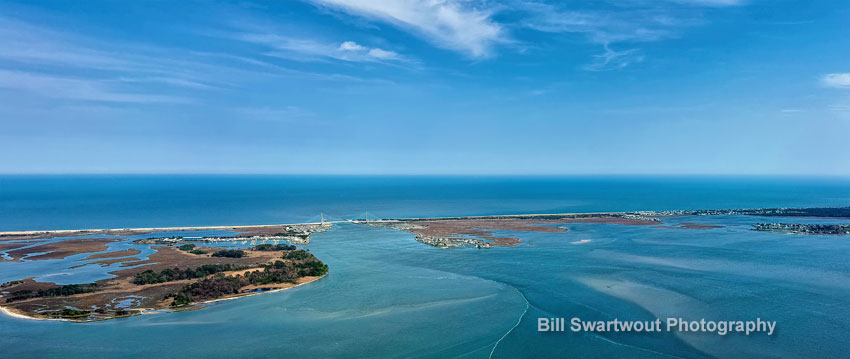
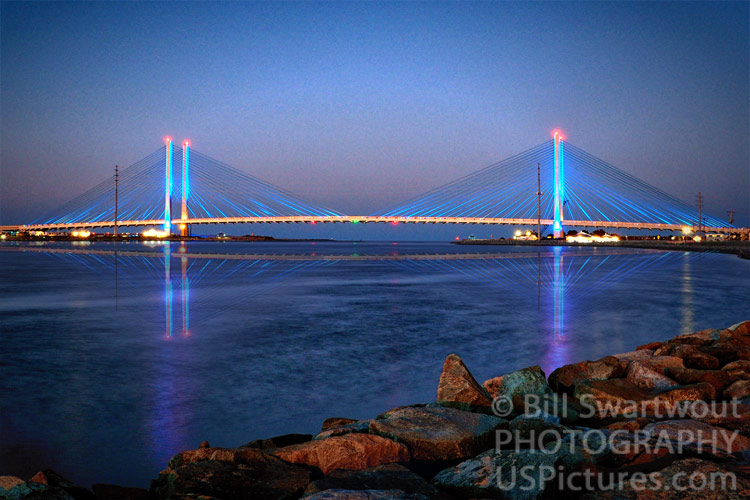
Coastal Delaware with Burton Island and the Indian River Inlet Bridge – between Dewey Beach and Bethany Beach
Now, there’s a world of difference between those random “snapshots” you take of your cat looking like a loaf of bread and the artful photographs captured by someone who knows what they’re doing. It’s not about having a bazooka-sized camera; it’s about having the eye of an eagle and the instincts of a ninja.
Armed with a 12-megapixel smartphone, a savvy photographer can create images so stunning they’d make even Mona Lisa crack a smile. Who needs a fancy camera when you can print a photo the size of a small elephant and still have it look like art? So next time you’re tempted to blame your phone for your lackluster photos, remember—it’s not the size of the camera, it’s how you use it!
Of course, that photograph is available for you. CLICK HERE
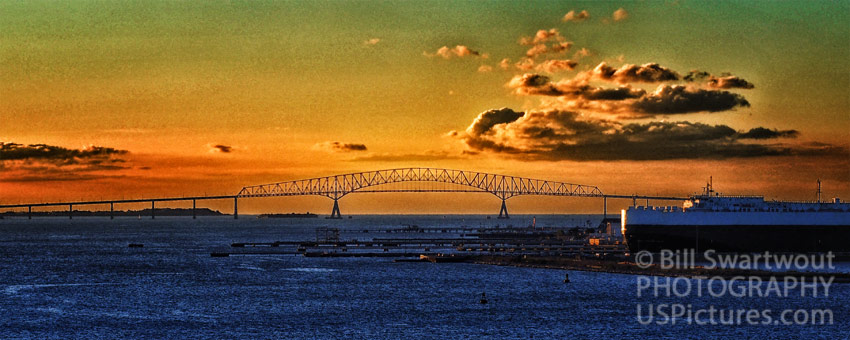
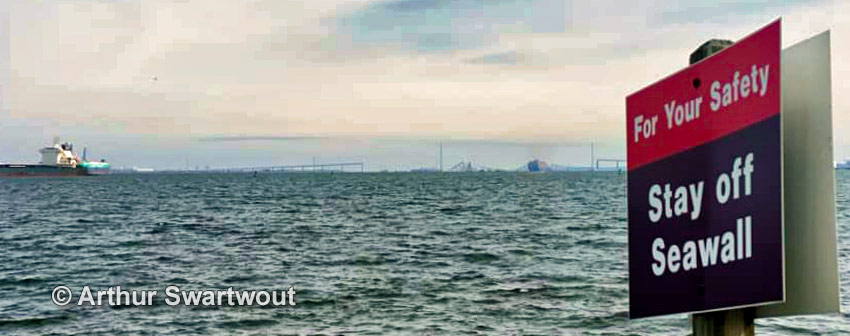
A tragic ship collision caused the Key Bridge to collapse like a house of cards on March 26, 2024.
In the wee hours of a cold March morning, a large freighter, the Dali, lost power and steerage control and collided with a major support of the Francis Scott Key Bridge in Baltimore, Maryland. The collision occurred at 1:28 AM and caused the main supporting structure to fail and the bridge spans to, literally, fall apart.
Imagine the chaos that ensued when a massive freighter collided with the Francis Scott Key Bridge, causing sections to collapse into the Patapsco River below. The sheer force of impact from the container ship left onlookers stunned and authorities scrambling to respond to this unprecedented disaster. As emergency crews rushed to the scene, questions arose about how such a catastrophe could have occurred in one of the busiest waterways in Maryland. This disaster effectively closed the (very busy) Port of Baltimore for an indeterminant length of time.
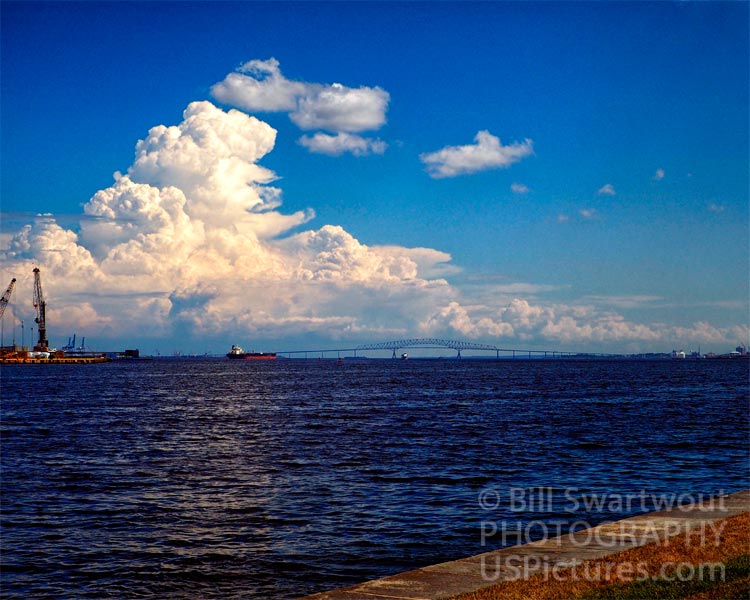
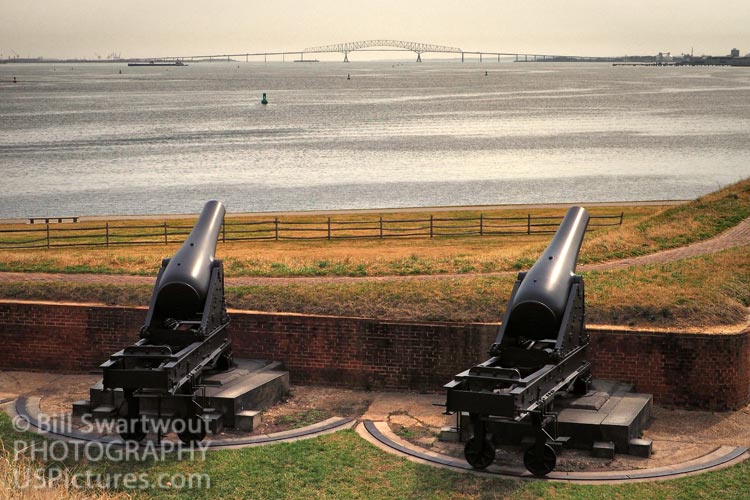
Francis Scott Key Bridge as seen from the sea wall at Fort McHenry in 2017, 40 years after it opened.
The Key Bridge was opened for use in 1977. This author can remember watching the construction process for the years before the opening. The full name is, of course, derived from the lawyer, Francis Scott Key, who penned the words to our National Anthem, the Star Spangled Banner.
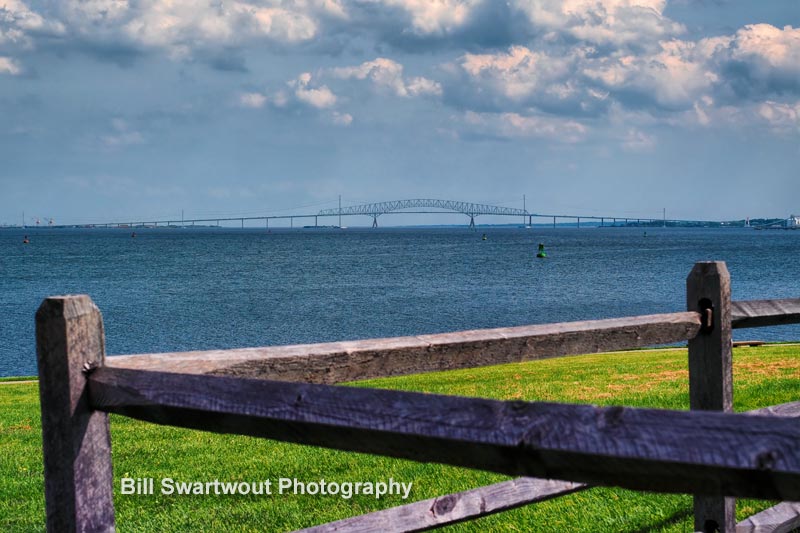
FSK Bridge as seen from Fort McHenry, about four miles to the west.
In conclusion
The collapse of the Francis Scott Key Bridge in Baltimore sent shockwaves through the city as the iconic structure crumbled into the Patapsco River. The aftermath of the bridge collapse revealed a startling vulnerability in our infrastructure and raised concerns about the safety of maritime navigation through this vital transportation corridor at the state and national levels. Investigations underway and repair efforts are already being planned. One can’t help but wonder about the long-term implications of this incident on shipping traffic and regional economy. As we await updates on this developing story, it’s clear that lessons must be learned from this tragic event to prevent similar disasters in the future.
Francis Scott Key Bridge the day after the collapse – Photo by Arthur Swartwout.
For many, this catastrophic event raised questions about infrastructure resilience and safety in a rapidly changing world. In moments like these, we are reminded that even our most trusted landmarks are vulnerable to unexpected challenges and that vigilance and care must be paramount in safeguarding our communities from potential disaster.
Francis Scott Key Bridge from the Rodman Cannons at Fort McHenry
Visit www.FSKBridge.com for more photos of the Key Bridge as it used to be.
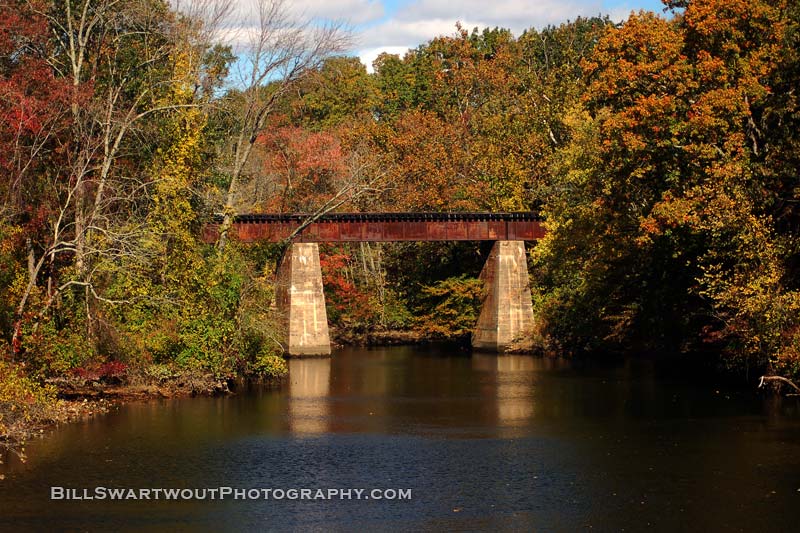
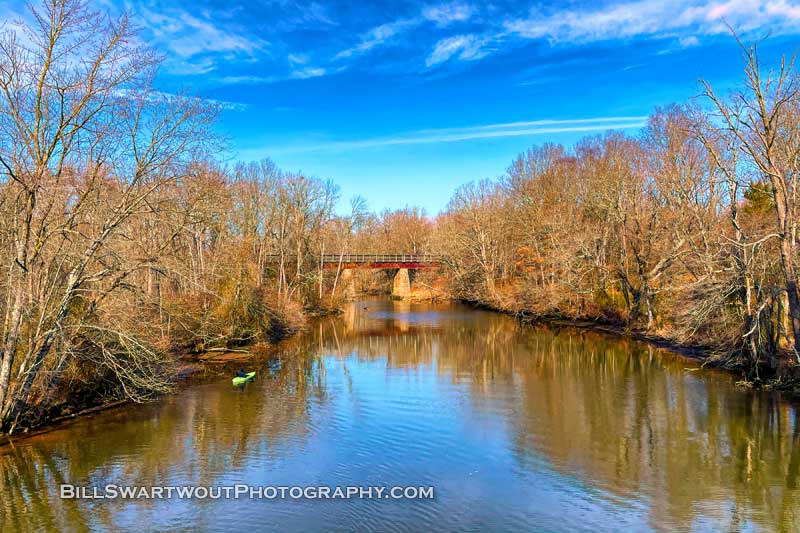
Historic Train bridge over the river at Tuckahoe River State Park in Queen Anne, MD
Over the river and through the woods to grandmother’s house we go in a make-believe train at the Tuckahoe State Park. The bridge has been out of service for many, many years but still stands over the Tuckahoe River along Route 404 in the center of the Delmarva Peninsula, the Eastern Shore of Maryland.
Tuckahoe River Railroad Bridge in the Fall.
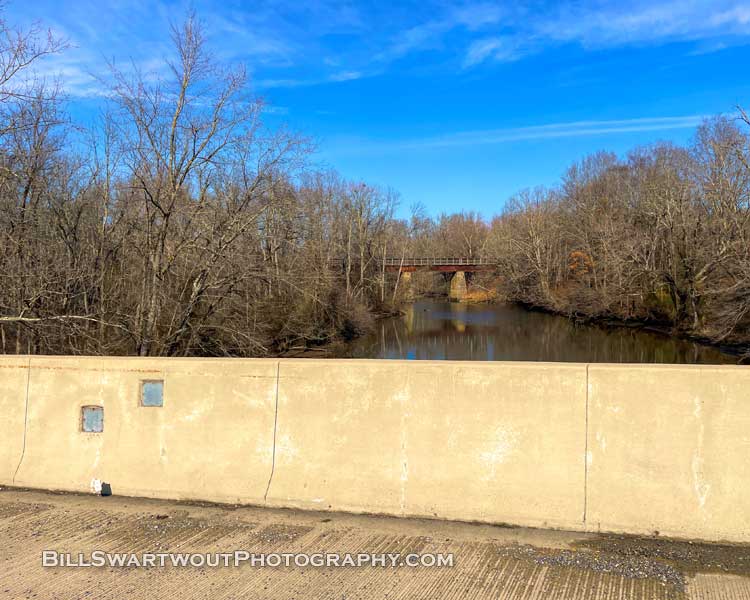
Tuckahoe River Railroad Bridge as see from a car driving past on Route 404 – getting to see this for a fraction of a second.
The Tuckahoe River Railroad Bridge in Queen Anne, MD is a beautiful and important landmark that has been part of the community for over 100 years. Located near the intersection of Route 404 and Route 50, this bridge is an integral part of the local history. Built in 1909, the Tuckahoe River Railroad Bridge stands as a testament to the engineering genius of its creators. Tucked away in the woods and now partially overgrown, this bridge is quite hard to find. It was originally built by the Pennsylvania Railroad and is a one-lane concrete and steel structure that spans the Tuckahoe River. Its overall length is over 100 feet and it stands 26 feet tall. The bridge is located at the southern border of the Tuckahoe River State Park and is “briefly” visible to vehicles passing by on Maryland Route 404 near Queen Anne, Maryland.
“Tuckahoe State Park is a public recreation area located along Tuckahoe Creek in Caroline and Queen Anne’s counties on the Eastern Shore of Maryland, United States. Adkins Arboretum, a garden and preserve maintaining over 600 native plant species, occupies 500 acres of the park.” (from :Wikipedia)
The above photograph was taken in 2014 and has been a popular image of Bill Swartwout Photography’s online gallery. So, of course prints are available along with a variety of home decor items.
Created with Photographs by Bill Swartwout Photography
October, November and December are the months for calendars – plan for 2023. #ShopEarly #BuyIntoArt Assateague Ponies, Ocean City, Indian River Bridge and Fire Control Towers are what I have created from my photographs and offer for sale at the amazing “Zazzle.” Click the image or the link below the image to browse of shop…
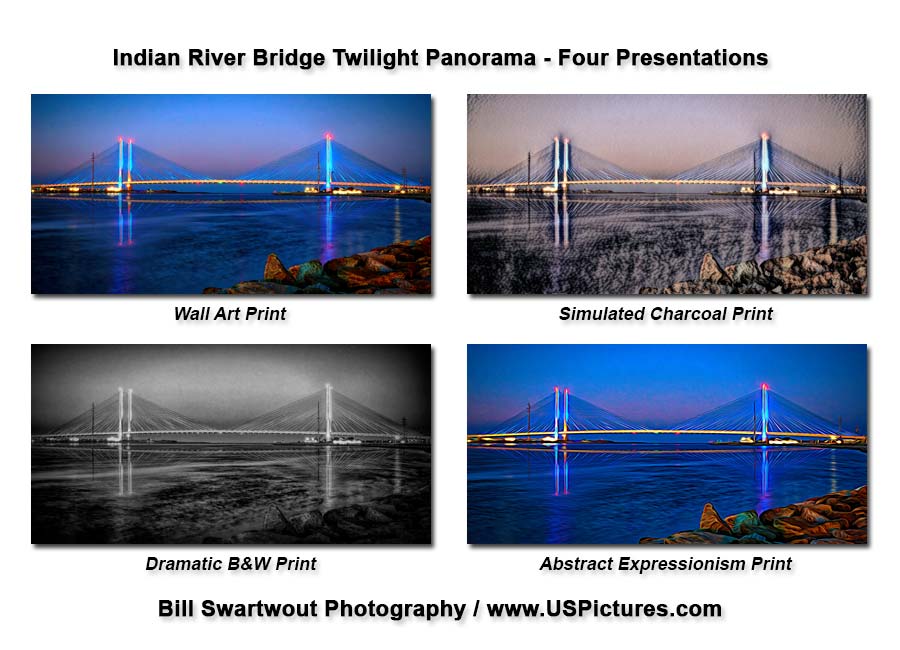
Four styles of this popular photograph are now available in a 2:1 panorama ratio.
I’ve had requests for a more-panorama-shape of one of my most popular photographs of the Indian River Inlet Bridge. So I made a “regular” Panorama (2:1 ratio) and three additional presentations. Might you be interested in any of these please let me know. If so, which one? Leave a response in the comments section at the bottom of the page.
Indian River Inlet Bridge at Twilight Panorama Photograph in Four Presentations.
The Charles W. Cullen Bridge is the official name of this beautiful example of cable-stayed suspension bridge architecture. The Indian River Inlet Bridge carries coastal traffic on Route 1 across the Indian River Inlet just north of Bethany Beach Delaware.
This beautiful structure is sight to behold at any time of day or night. However, twilight, the transition between day and night, brings out the spectacular color of the bridge, the water and the sky – all in shades of blue – at this magical time.
The Indian River inlet joins the Rehoboth Bay and the Indian River Bay with the Atlantic Ocean. The Indian River Bridge over the inlet allows traffic to flow north and south along “Coastal Highway” (Route 1), connecting several beach resort towns from Ocean City in Maryland to Rehoboth Beach and Lewes in Delaware.
The Delaware Seashore State Park facilities on both the north and south sides of the Indian River Inlet and along the shore of the Indian River Bay attract thousands or people, who can enjoy sights like this, all year ’round. The area, just north of Bethany Beach, DE boasts campgrounds, a large marina, fishing and, of course, a well-maintained and guarded (in season) beach on the Atlantic Ocean.
The original “best selling” print: Indian River Inlet Bridge Twilight Reflection
Charles W. Cullen Bridge – Dedicated 2012
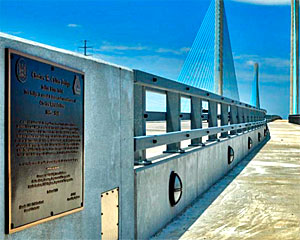
Dedication Plaque on the Indian River Bridge Pedestrian Walkway
This bridge is named in honor and remembrance of Charles West Cullen, 1865-1948, a man who dedicated his life to public service and the the citizens of Delaware. Between 1930 and 1940, he served on the State Highway Commission, eventually being elevated to Chairman of the Commission from 1938-1939. While he was Chairman, work was started on a new bridge to span the Indian River Inlet. In recognition for his service on the Commission, the bridge was dedicated on May 18, 1940, in his name for his advocacy for the proper opening of the inlet and the internal development of the Indian River. Two additional bridges bearing his name have spanned the inlet since that time. This, the fifth bridge to span the inlet waterway, is was also dedicated in his name. (Paraphrased from the bridge dedication plaque.)
Use the links below to browse or shop more of Bill’s photographs of the Indian River Inlet Bridge.
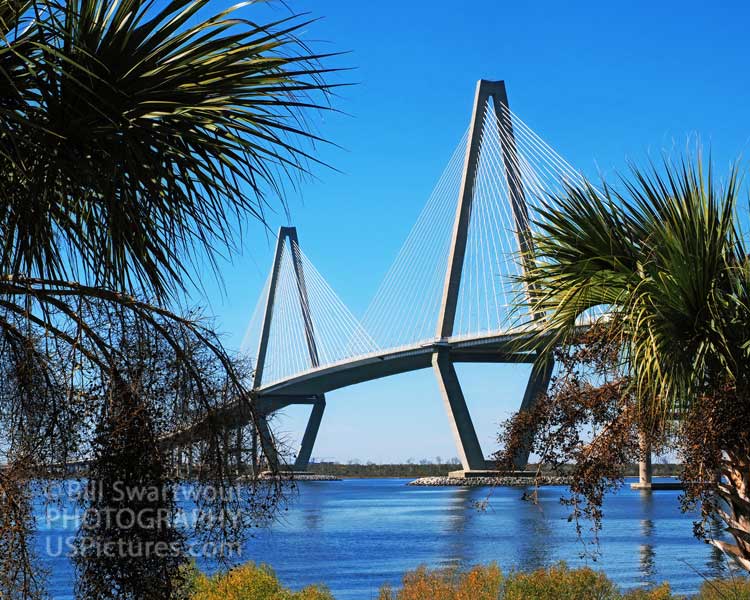
Framed by palm trees, this picturesque bridge photograph will look wonderful in your home or office.
The Arthur Ravenel Jr. Bridge is an architectural wonder. Designed by the renowned firm of Cline Design Associates, this cable-stayed bridge spans the Cooper River and connects Charleston to Mount Pleasant, South Carolina. This bridge was opened on July 16, 2005 and replaced two older bridges, the Silas N. Pearman Bridge and the John P. Grace Memorial Bridge (built in 1929 and 1966).
An architectural wonder, the Arthur Ravenel, Jr. Bridge crosses the Cooper River at Charleston, South Carolina.
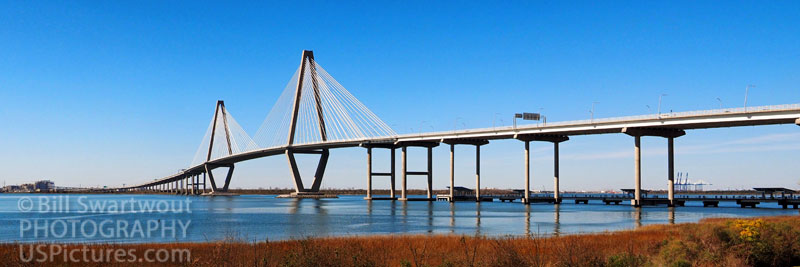
At a total length of 13,200 feet this is the third longest cable-stayed bridge in the western hemisphere with a main span of 1,546 feet and a clearance of 187 feet. In 2006, it won an Outstanding Civil Engineering Achievement award from ASCE for its innovative design and materials. The bridge has eight lanes for vehicular travel and two bicycle/pedestrian lanes so you can see it up close!
Arthur Ravenel Jr. Bridge Panorama Format 3:1
An infrastructure wonder, it is the third longest cable-stayed bridge in the western hemisphere and offers panoramic views that are especially striking at sunset.
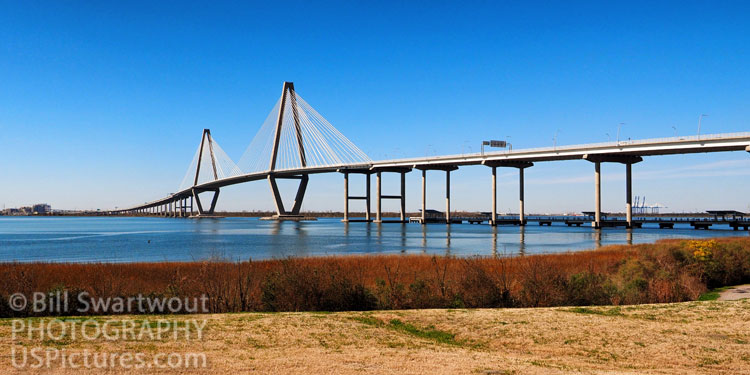
Arthur Ravenel Jr. Bridge Panorama Format 2:1
The Arthur Ravenel, Jr. Bridge (sometimes referred to as the New Cooper River Bridge) is a cable-stayed bridge over the Cooper River in South Carolina. Opened to traffic nearly two decades ago, the 1,546 foot long bridge carries eight travel lanes and two wide outside shoulders. It is held aloft by two 600-foot concrete pylons that support a 650-foot center span and a pair of 350-foot side spans. Total length of the bridge is 13,200 feet or 2.5 miles. With its main span rising only 187 feet above mean high water, the bridge carries Interstate 526 across Charleston Harbor from Patriots Point to U.S. Highway 17 at Mount Pleasant.
The Arthur Ravenel Jr. Bridge is a cable-stayed bridge over the Cooper River in South Carolina, connecting Charleston to Mount Pleasant. It replaced two obsolete cantilever truss bridges. Its eight lanes carry U.S. Highway 17, U.S. Highway 52, and South Carolina Highway 7 as it crosses the river, with a dedicated bicycle and pedestrian lane along the northern side of the bridge.
Imagine if a bridge could talk: “I am the Arthur Ravenel Jr. Bridge in South Carolina, named after a politician who served as state senator and member of the United States House of Representatives. I am a cable-stayed bridge that crosses the Cooper River at Charleston, South Carolina. I opened on July 16, 2005, and was built to replace two aging bridges: one which carried U.S. Route 17 over the Cooper River and another which carried U.S. Route 17 over the Wando River. I connect Charleston to Mount Pleasant, South Carolina.
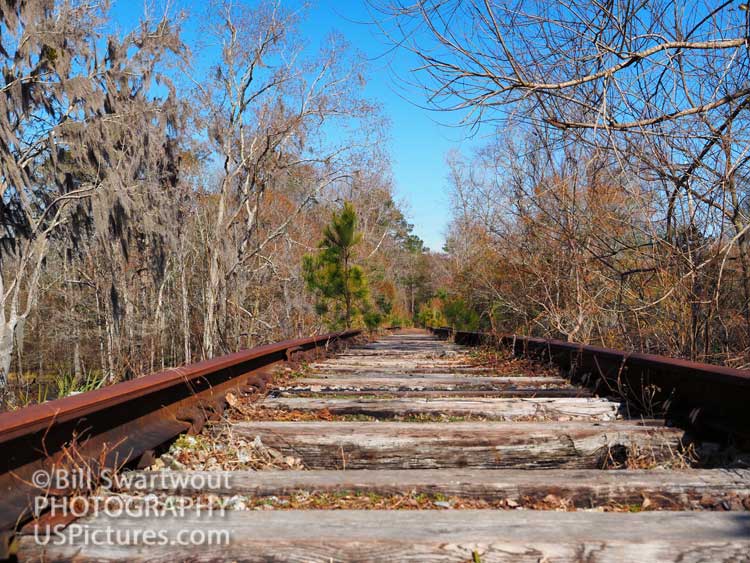
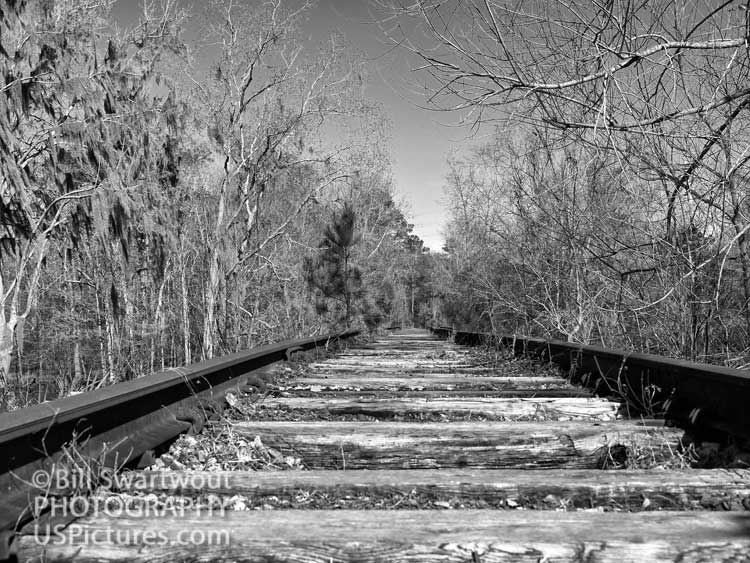
The the remaining tracks of an abandoned railroad make for interesting scenery.
The Waccamaw Coast Line Railroad use to carry passengers and freight from Conway to Myrtle Beach. The line has been abandoned since the 1990’s but the remaining tracks make for interesting scenery. The old railroad bridge cannot be seen in this particular view but it’s out there. You can visit this scene while walking the Riverwalk along the Waccamaw River as it flows through Conway, South Carolina.
Waccamaw Coast Line Railroad Abandoned Tracks
The next time I am in Conway, I plan to hike along this old railbed to cross the river and photograph the old swing-bridge. The photograph below is in black and white which helps bring out the texture of the decaying railroad ties and the overgrowth of trees and brush that is reclaiming this thoroughfare – taking it back to nature.
Waccamaw Coast Line Railroad Abandoned Tracks in Black and White
Use the links below to see more of these images and how they look on different wall art substrates. There are prints, framed prints, canvas presentations, acrylic and more.
Little information remains about the Waccamaw CoastLine Railroad. I could find only bits and pieces of information and one mention of abandoned trackage. The Atlantic Coast Line served this line when it was first constructed by the Waccamaw, Conway & Aynor Railway between 1916 and late 1919 to serve lumber and naval stores traffic. It was then acquired by the ACL in December 1919 and became an extension of the Myrtle Beach Branch. The line survived as a freight only branch until the early 1980’s when passenger service was briefly revived with various excursion trains operated by Inland Rail Tours. At some point the name was changed to Waccamaw Coast Line – probably around 1987 but service continued for only a short time and was discontinued in the early 1990’s.
Overall, the WCL RR was an obscure experiment in intrastate railroading that didn’t last all that long. But at least it had a good run while it lasted, even if only a handful of people were aware of its existence and, that, is what may have been what caused its demise.
This historic Bridge in Conway, South Carolina carries travelers across the Waccamaw River.
Built in 1937, the Waccamaw Memorial Bridge (also referred to as the Conway Memorial Bridge) is a historic plate-girder bridge in Conway, Horry County, South Carolina. This plate deck girder bridge, with Gothic-style arches is designated a memorial to Horry County soldiers who served in America’s wars from the Revolution to World War I. This bridge was built to relieve the traffic congestion of the original one-lane bridge as popularity grew for the Grand Strand resort of Myrtle Beach. It was listed under National Register of Historic Places on October 12, 1999.
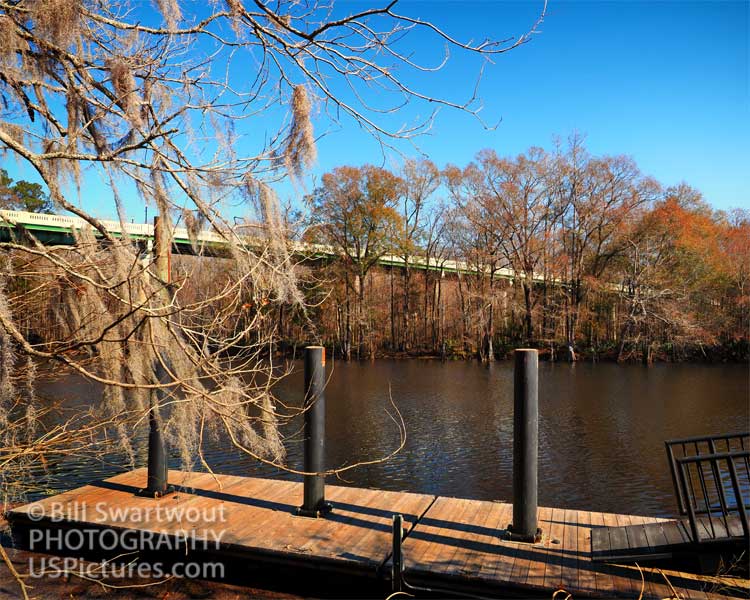
Conway Memorial Bridge over the Waccamaw River in Conway, Horry County, South Carolina.
This photograph was taken while enjoying a walk along part of the Conway Riverwalk. The Riverwalk is a sculpted boardwalk with railings along much of the town’s waterfront on the Waccamaw River. If you, one day, get to visit Conway, be sure not to miss a stroll along the river.
Conceived a the height of the Great Depression and at a cost of $370,000, Horry County’s fifth bridge across the Waccamaw River was constructed just prior to the years of World War II. The Waccamaw River Bridge carries Business Route U.S. Highway 501 over top of the Waccamaw River connecting North Conway to Aynor/Yauhannah, South Carolina.
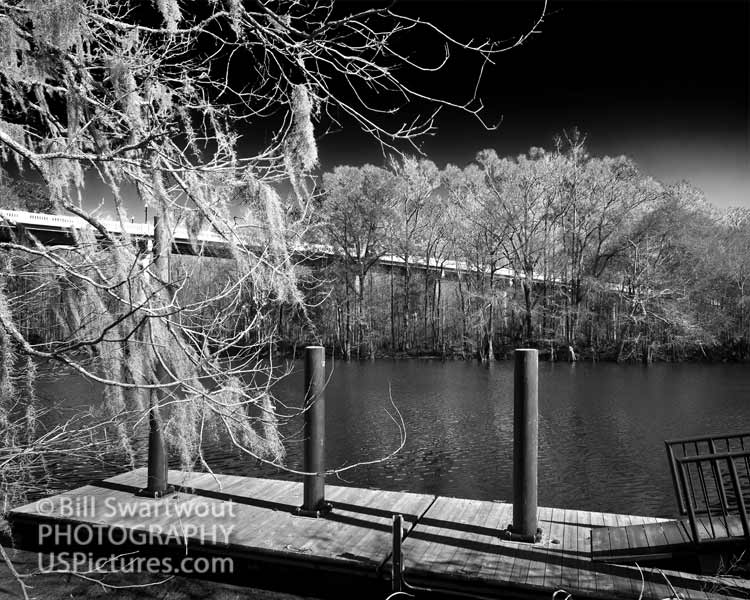
The Waccamaw River Memorial Bridge in a Black and White Presentation
Click the photo above or the links below to see wall art with this image along with an assortment of home decor items.
What’s that, Myrtle Beach? You’ve been under stress from the lack of a second bridge crossing the Waccamaw River for half a century? Well, we’ve got just the thing to lift your spirits: The Waccamaw River Memorial Bridge! This historic bridge is located in Conway, South Carolina, and carries travelers over the Waccamaw River. It was built in 1937 as a replacement for the original bridge (built in 1921), which could not accommodate all of the travelers to and from Grand Strand resorts. The new bridge was designed as a plate deck girder bridge in a Gothic-style arch with reinforced concrete piers, abutments and wing walls. In 1998, the State of South Carolina designated the bridge as a memorial to Horry County soldiers who served in America’s wars from the Revolution to World War I. This made it one of two bridges in South Carolina with such designation (the other is located near Kingstree). The bridge spans 1,024 feet (312 m) across the river, including approach spans. It measures 16 feet (4.9 m) wide and 8 feet (2.4 m) high.
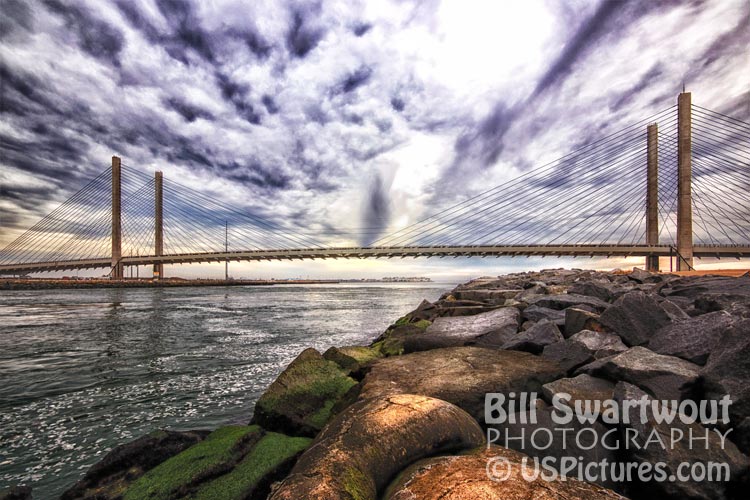
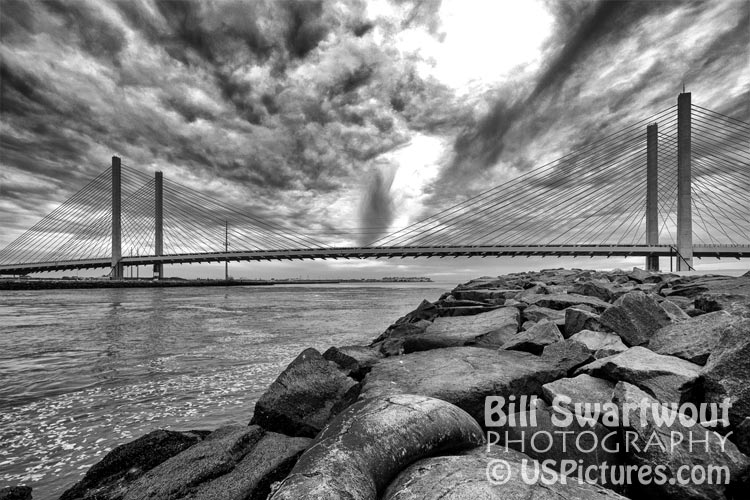
The Indian River Inlet Bridge near Bethany Beach, DE appears different every time we are there.
These clouds predict the onset of a storm but, in this case it was just an illusion. It was 40 degrees and windy, up from a low of 19, when this photograph was captured.
The George W. Cullen Bridge over the Indian River Inlet is located between the coastal towns of Dewey Beach and Bethany Beach , Delaware. It is surrounded by the public beach, marina and campground facilities of the Delaware Seashore State Park.
Indian River Bridge Clouds
In addition to the full color version, this is the black and white presentation “Indian River Bridge Clouds” and is unique in its own right.
Indian River Bridge Clouds in Black and White
Use the links below to see larger versions of the Indian River Bridge Clouds and to browse or shop the variety of wall art and home decor items available.
When I wanted to photograph the Indian River Inlet Bridge near Bethany Beach, DE I knew that weather could be an obstacle. Sure enough, before sunset a warm front arrived, with at layers of clouds moving in from the west. But this time Mother Nature played a trick on me. The sky was filled with these ominous clouds and snow flurries started to fall, much like in this photograph. Even though it was cold and the wind was blowing, I had to wait until everything came together. I was hoping for a bit more color. But this cloudy scene doesn’t lack interest – in my opinion. Toned sky, ragged clouds and stark and empty rocky jetty on the north side of the Indian River Inlet are what makes this scene so striking!
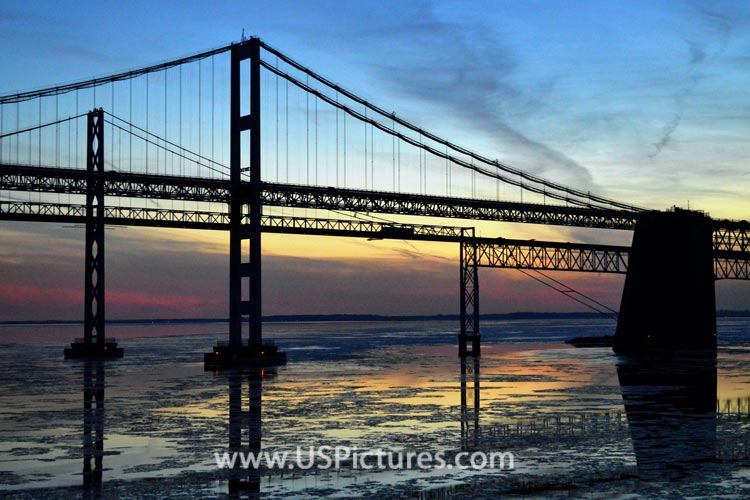
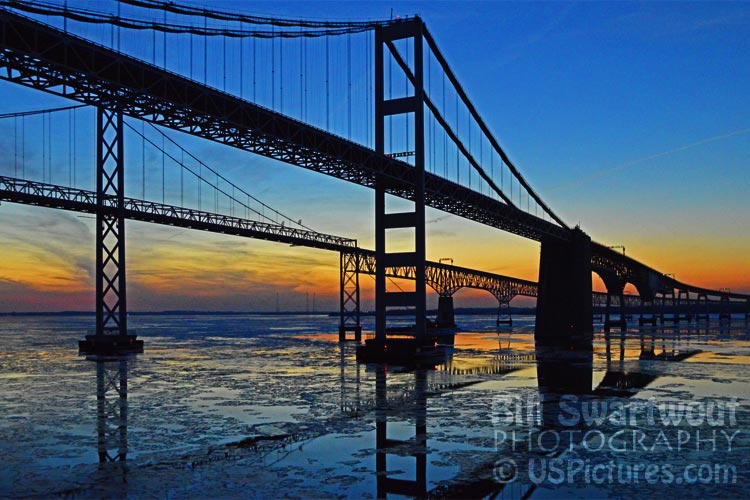
From a cold January cruise underneath the Chesapeake Bay Bridge
Another of my older photographs dates back to January 31, 2014 and a winter cruise to warm Caribbean islands and sunshine. The frozen waters beneath the Chesapeake Bay Bridge reflect the waning light of the last sunset on the last day of January, 2014. We do not see an icy Chesapeake Bay like this very often and this particular combination of lighting and ice floes in the Bay may never be seen again.
Officially, the William Preston Lane, Jr. Memorial Bridge, this dual structure spans over four miles of the Chesapeake Bay connecting Maryland’s Western Shore to Kent Island and the Maryland Eastern Shore on the Delmarva Peninsula. Standing 186 feet high at the highest point, this bridge instills fear in the hearts of many drivers who cross it. However, most drivers and passengers simply revel in the beauty of this engineering marvel.
The above are two slightly different views of this rare occurrence of seeing ice floes as far south as the Chesapeake Bay Bridge. The orange light of the setting sun adds to the dramatic impact of this scene and is likely something that will not be photographed again. Yes, it was cold on the top deck of the Grandeur of the Seas when I shot these photographs but certainly not as cold as being in the water.