Wild horses of Assateague Island National Seashore simply walk along any road they choose…
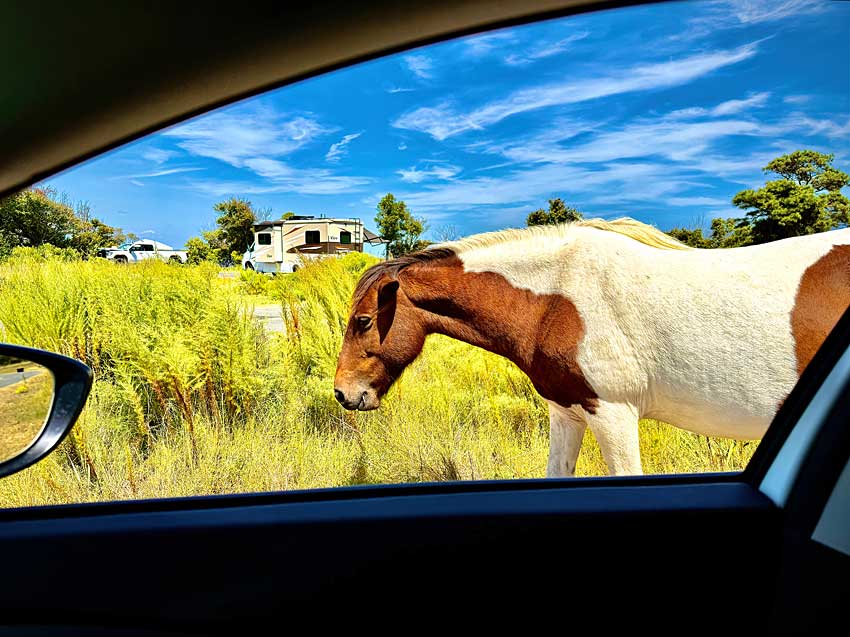
A brown and white wild horse from Assateague Island struts along the side of the road, looking as nonchalant as a celebrity on a red carpet. Captured through the car window, she seems to be weighing her options — maybe she’s thinking about hitching a ride or simply flaunting her fabulous mane.
No Assateague Pony hitchhikers, please.
This is no ordinary road; it’s on the iconic Assateague Island National Seashore in Maryland, where wild horses roam free and RVs park like they own the place. The backdrop is a delightful mess of green shrubs that seem to whisper secrets to one another while keeping an eye on our equine friend.
As campers sip their coffee and take selfies, our horse is clearly the star of the show, basking under a clear blue sky. She might even be contemplating becoming an Instagram influencer — #HorseGoals anyone?
In this bright and natural setting, wildlife and human activity coexist in perfect harmony — or at least until someone tries to feed her a hot dog!
Be sure to visit Bill’s Assateague Island Photography Collection: CLICK HERE.
Bushel Basket Holiday trees in Grasonville, MD and throughout Delmarva…
Celebrating the Watermen of the Chesapeake Bay is series of non-traditional Christmas trees, three of which are located at the Fisherman’s Village complex, just east of Kent Island.
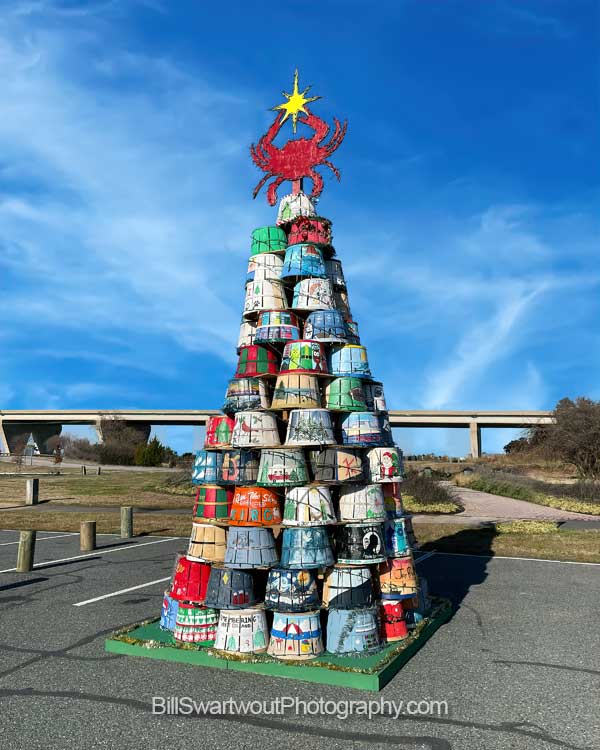
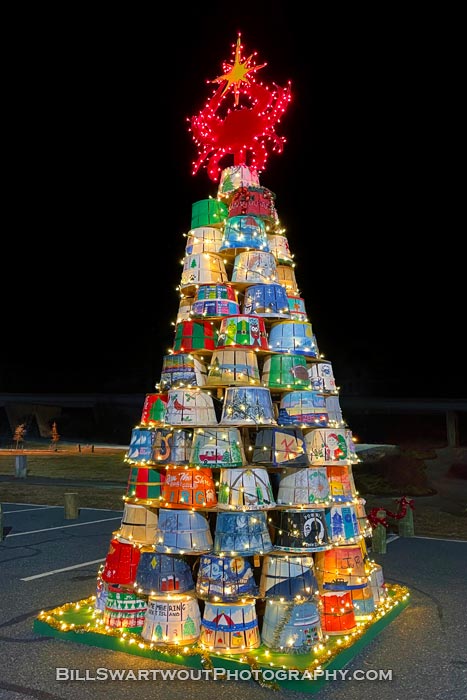
Crab Basket Christmas Tree at the Kent Narrows in Grasonville, MD. Note, please, that utility poles, wires vehicles and advertising signs have been “removed” from the original image.
Merry Crabby Christmas – Merry Crabness. This tree, along with two others are located at the Waterman’s Memorial in Grasonville, Queen Anne’s County, MD. Bushel Basket Trees are a common site on the Eastern Shore in several of the small water-oriented towns. Other sightings: Cambridge, Rock Hall, St. Michaels, Berlin (on the road to Assateague Island). In Maine and other New England states they have lobster trap trees – similar but not the same as “From the Land of Pleasant Living on the Eastern Shore!”
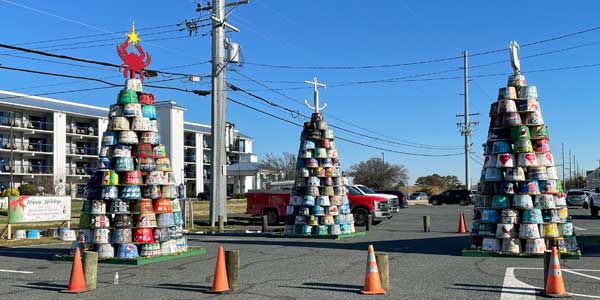
Three Bushel Basket Christmas Trees in Graysonville, MD
We got started on this photo project because we saw a picture and then found this bit of description on a Facebook post: “These baskets are at fishermans inn in Grasonville , they also have a lot of meaning , mostly not all but a lot have our local waterman’s names and drawn pictures of their boats ect on them that worked on the water most of their lives its located at the watermans memorial , I think there is 3 trees this year” (by Commenter, Michael Timms)
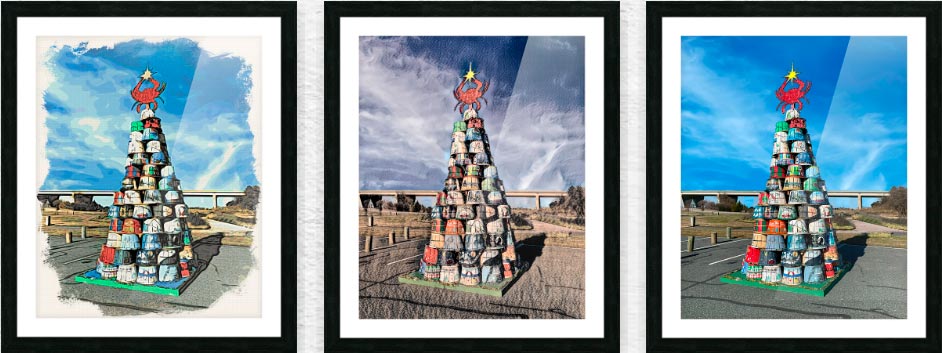
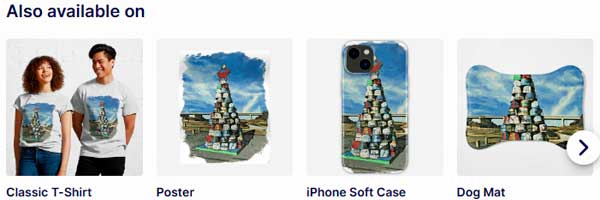
Here are three popular variations of the crab-topped Crab Basket Holiday Tree featured above. They are (l to r) a simulated watercolor painting, a simulated charcoal drawing and the original photograph presentation.
Interesting items about the Crab Basket Holiday Trees
Each tree has a meaning and each basket has a meaning: history, celebration, honor, remembering and/or holiday spirit.
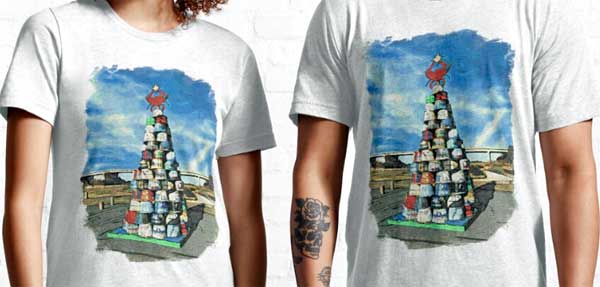
The watercolor rendition of the Crab Basket Tree looks great as a T-shirt design.
202 baskets were used to make the first tree that was erected in Kent Narrows in 2020.
There was so much interest that two trees were created in 2022.
Interest continued to grow – with three trees being constructed in 2023.
Located at the Fisherman’s Village complex at the Kent Narrows (Kent Island Narrows), Grasonville, MD.
Every painted basket has a “story” to honor and/or remember someone or may simply be to share the holiday spirit.
There are “memorial baskets” to honor watermen who passed away in the previous year.
Proceeds from project activities support local watermen and families in need.
Basket painting was done by local citizens of all ages.
Each tree has a meaning and each basket has a meaning. Themes might include history, celebration, honor, remembering someone and/or simply the joy of holiday spirit.
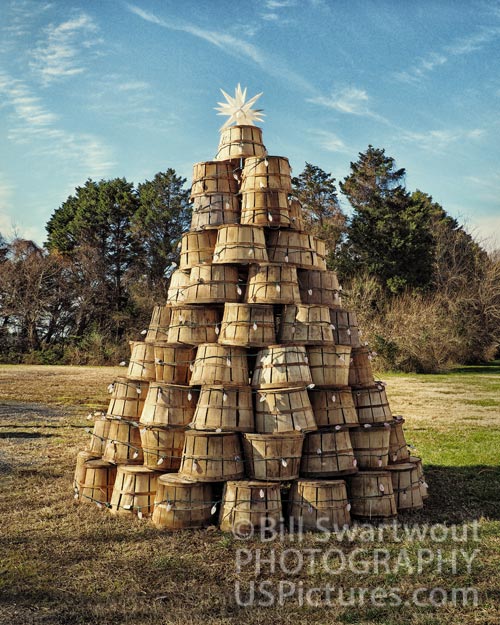
Here is a Bushel Basket Christmas Tree found near the town of Berlin, MD along Route 611.
Crab Bushel Basket Christmas Tree Near Assateague Island, MD
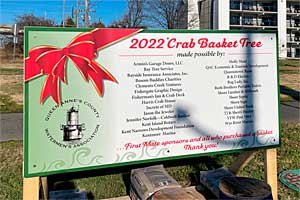
Watermen’s Association 2022 Crab Basket Tree sponsor sign.
These trees would not be possible without the support of generous sponsors. The sign thanking/acknowledging them, erected by the Queen Anne’s County Watermen’s Association, is located at the site.
The Sponsors listed are: Armin’s Garage Doors LLC, Bay Tree Service, Bayside Insurance Associates Inc, Clements Creek Ventures, Fishergate Graphic Design, Fisherman’s Inn & Crab Deck, Harris Crab House, Jennifer Norfolk–Coldwell Banker, Kent Island Rotary, Kent Narrows Development Foundation, Kentmorr Marina, Molly Maid, QAC Economic & Tourism Development, Queenstown Bank, R&D Electric, Rag Lady Inc, Ruth Brothers Portable Toilets, Shore Lumber & Millwork, Shore Septic, Shore Sign, Shore United Bank, TJ & Sherri Hunter, VFW Post 7464, and Wye River Marine. The sign is thanking … First Mate sponsors and all who purchased a basket. Thank you!
Christmas Lights
Of course a Christmas Tree need lights for viewing at night. These Crab Basket Trees are no exception.
The Crab Basket Christmas Tree is lighted at night.
Yes, you can purchase the wall art photographs in a variety of substrates as well as on Home Decor, Apparel and Other Items.
This Egret fishes from the Fishing Pier at Myrtle Beach State Park
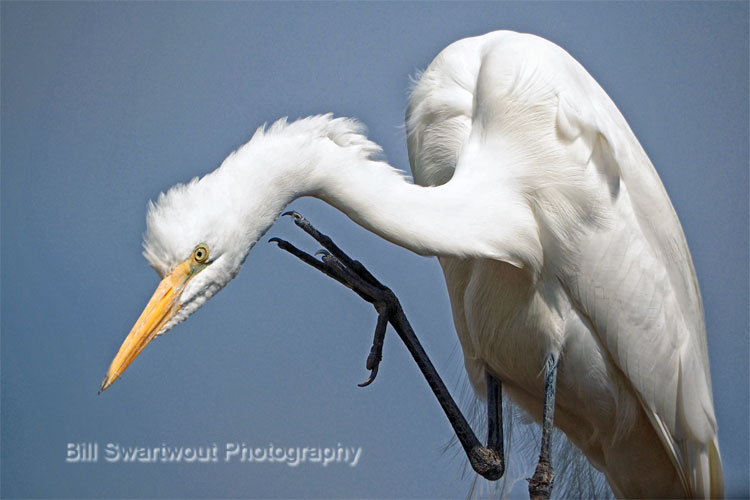
I met Randy, the Great Egret (Ardea alba) , at Myrtle Beach State Park on a recent road trip. He was standing on top of the shelter on the fishing pier and, evidently, had a great itch. The beautiful white plumage and the regal posture of this fascinating bird makes him really stand out in a crowd, so to speak. One cannot help but notice him as he struts around acting so sure of himself.
Randy, the Great Egret at Myrtle Beach State Park, appears to be scratching an itch.
No, I did not name him. A couple of fishermen on the pier told me he hangs around so much they all call him Randy. He keeps an eye on the fishing lines and is quick to react whenever a fish spits out a hook and tries to swim away. Seems like easy picking to me – smart bird.
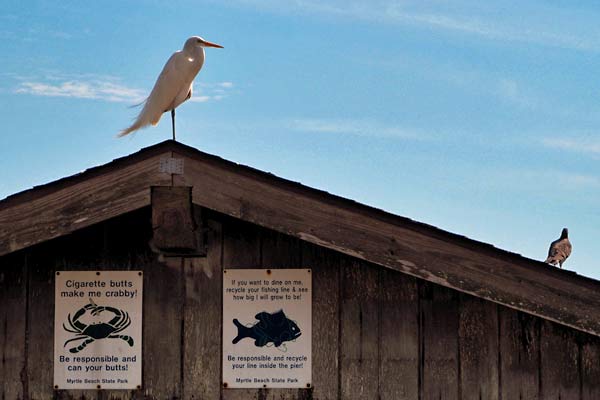
Randy, the Great Egret, keeps an eye on things from his perch atop the shelter on the fishing pier.
Here’s a picture of Randy, the Great Egret, in an advantageous location on top of the pavilion on the pier. From this vantage point he can keep an eye on everyone and every thing. He seems to trust the fishermen on the pier more that he does the fact that a fish might throw a hook and get away. Randy tries to make sure that nothing “tasty” gets away.
The great egret is also known as the common egret or large egret. It is a wading bird found in both tropical and temperate regions. The great egret is long-legged and long-necked, with a long, thin bill. They are mostly white in color with black tips on their primary feathers. This makes them look almost as if they have been dipped in paint.
The great egrets has been known to live up to 20 years in captivity and up to 30 years in the wild. They feed mostly on fish, frogs, snakes and insects but will also eat reptiles, birds’ eggs and small mammals when needed. Their hunting style is very similar to that of an osprey or an eagle which means they will sit patiently waiting for prey to approach before striking quickly with their long sharp bill which can be up to two feet long!
Great Egrets are monogamous birds meaning they mate for life which usually lasts about 5 years before one dies off leaving behind one chick who will then be cared for by both parents until it reaches maturity at 2 years old when it can fly off into the sunset on its own
While this particular bird was photographed on the fishing pier at Myrtle Beach State Park in South Carolina, this just as easily might be see at any of several fishing piers along the east coast. There are many “Ralphs” just looking for an easy meal. The great egret is also known as the common egret, large egret, or great white egret or even the great white heron.
Photographs of this Great Egret are available at my online stores on a variety of substrates and also on home decor items. Use the links below to shop.
The great white egret is a magnificent bird, with a wingspan that can reach up to seven feet. Its bill is long, thin and black at the tip. It is used for catching fish and insects in shallow water or wetlands. The great white egret has dark legs that are set far back on its body. It has a long neck and head with a large yellow bill.
This bird can be found in North America, Central America and South America as well as Eurasia and Africa. They tend to live near water where they build their nests which are made from sticks or reeds and lined with mud or grasses. A pair of great white egrets may mate for life; however, if one dies then another mate will usually be found soon after this happens during breeding season (March – June). They lay three eggs which hatch after about twenty days depending on temperature levels outside at this time of year (spring). The chicks will fledge after sixty days but continue feeding until about eighty days old when they become independent from their parents once again!
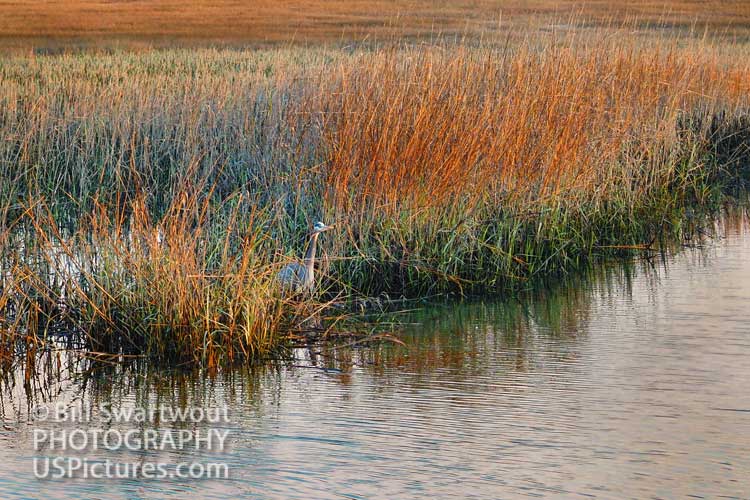
A Great Blue Heron hides among the marsh grasses fishing for a meal.
Fishing is a way of life in Murrells Inlet, and not just for those make their living at it. Fishing, both within the creek and in the ocean is a part of the history, a bond with the place and even among the inhabitants – both the humans and the lesser beasts and critters.
Marsh Grasses and a Great Blue Heron at Murrells Inlet in South Carolina
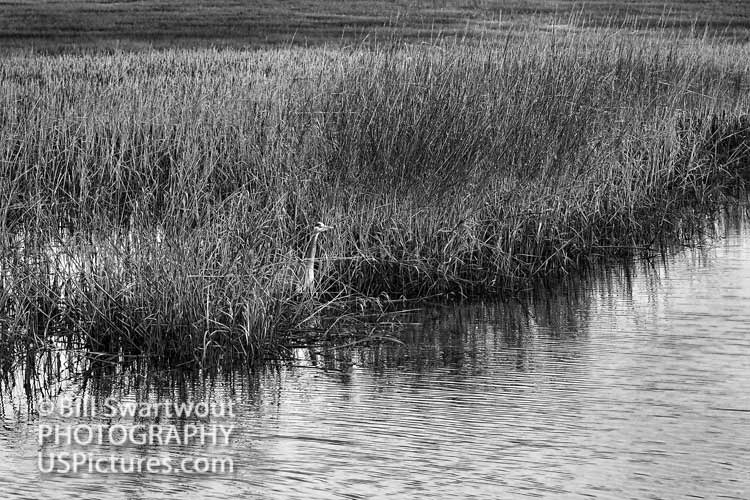
As the fishing depends on the fish, so the fish depend on the marsh and the entire ecosystem. This symbiotic relationship gives rise to some beautiful and unique scenery – that often looks as good in black and white as it does in full color.
Lurking in the March at Murrells Inlet in Black and White
From the time of its formation about 6,000 years ago, the Murrells Inlet saltmarsh has been a source of food for local inhabitants. Native Americans depended on the marsh for the seasonal provision of clams, oysters, and fish, a tradition which persisted through colonial and plantation times, and continues today. In the 20th century, recreational and commercial fishing broadened and increased local dependence upon the marsh.
Click the links below to see the wall art substrates available for these photographs.
Saltmarshes like Murrells Inlet provide a rich and sheltered habitat for fish, from baitfish like Mummichog and striped mullet on up to gamefish of the nearshore ocean, such as grouper. (Just naming two of many examples here.) This is because of the abundance and variety of food available within the marsh, and the relative absence of large predators (that Blue Heron notwithstanding). Scientists have found that more than 75 percent of nearshore ocean fish use the marsh at some stage of their life-cycle, for spawning, for juvenile growth and/or for a seasonal food source.
From an environmental standpoint, maintaining a healthy marsh is essential to maintaining a healthy ocean fishery. The long view values not only the fish, but the marsh that made the fish and, of course our friend, that long-legged fishing bird, lurking in the marsh.