Certificates of Authenticity show collectors/buyers that the work purchased is authentic and valuable.
A valid certificate, created for each product produced, will assure you this is an authorized and quality piece produced by a bonified production partner of Bill Swartwout Photography/US Pictures. This will give you reassurance that the piece you receive is not from some bogus Internet “scraper” or copyright-theft website.
Certificate of Authenticity for Photographs by Bill Swartwout Photography.
Each certificate of authenticity is completed by hand & identified by a unique traceable number with an hologram. The COA will be inserted at the back of your artwork or within your package if you order a paper print.
These are currently offered only through my Gallery Store at Pictorem. My Fine Art America Gallery Store is, of course, also authorized to produce my photographs on their wall art and decor products but they do not offer a Certificate of authenticity.
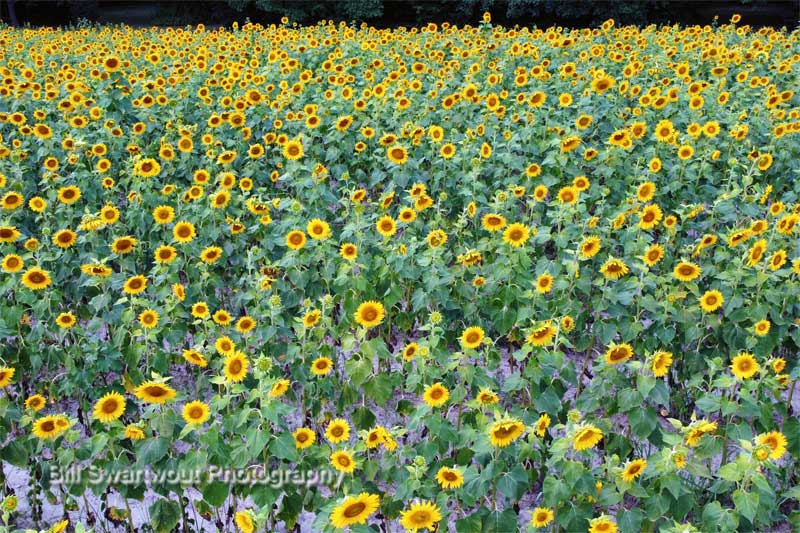
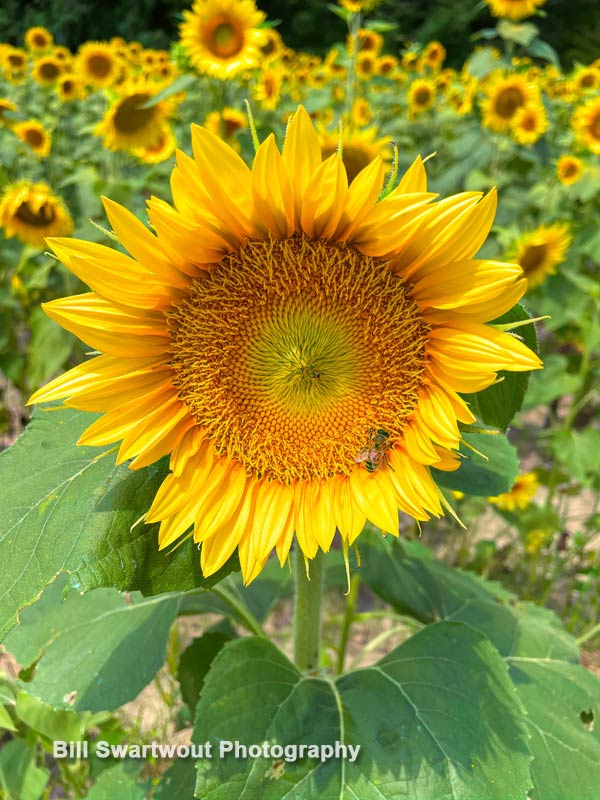
Nearly everyone loves sunflowers, the most popular flowers of summer.
The sunflower stands tall to meet the rays of the midday sun – it stands tall and reaches high into the sky. Golden hues of sunshine are reflected in the petals, making this wonderful yellow bloom among the most popular flowers of summer.
A field of bright yellow sunflowers is one of summer’s most popular sights and with good reason. These cheerful, cheerful flowers are easy to grow, requiring only a sunny spot to thrive. Sunflowers are also easy to customize for any occasion: add stakes or wire for height, use in bouquets, or leave them out as the centerpiece on your kitchen table. Did you know the the flower petals within a sunflower’s cluster are usually in a a spiral pattern?
Even the bees love sunflowers – for their sweet nectar.
Sunflowers are usually yellow or orange. They can also be red or white, but yellow is the most common color for sunflowers. The petals on each flower all face one direction, making the sunflower look like a bright disc when it faces the sun. Sunflowers are native to North America and were first cultivated by Native Americans.
What’s not to love about sunflowers? They’re bright and cheerful, they grow in fields and on farms, and they are the most popular flowers of summer.
In fact, sunflowers have been grown for thousands of years—and they weren’t even originally intended to be flowers! They were actually used as a food source by Native Americans. The seeds were ground into flour or roasted like popcorn. Every 100 pounds of sunflower seeds yields about 40 pounds of oil, 35 pounds of high-protein meal and 20 to 25 pounds of other by-products.
Sunflowers are native to North America, but now grow all over the world. They have become an important part of many cultures around the globe, including China, Africa and South America. When Europeans got their hands on the plant it quickly became one of their favorite things to grow in their gardens.
Heliotropism – a plant’s propensity to face, and follow, the sun…
A young sunflower has a supple stem that responds to the sun. The flower will follow the sun from its rising in the east to setting in the west. Over night the stem will tend to grow more on the west side – from the “afternoon sun” and will make the head swivel back toward the east. This repeats every day for a part of the plant’s growth cycle. But as the plant matures and the head becomes laden with seeds and quite heavy, it can no longer swivel during the day. Therefore the older, larger and mature sunflowers tend to face east – toward the rising sun – and stay that way until the harvest.
Use the links below to browse or shop more of Bill’s photographs of Sunflowers and other Flora .
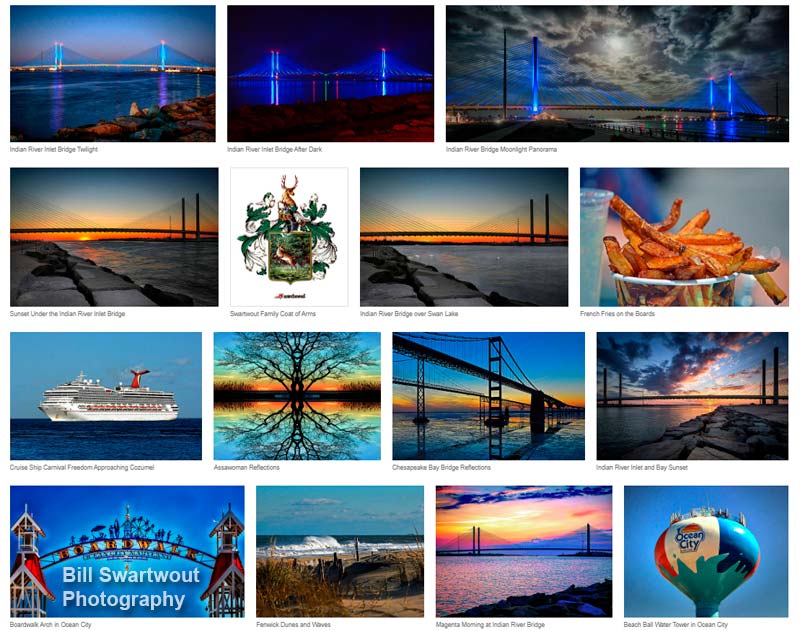
After many years with Fine Art America here are the overall favorites at Bill’s USPictures Gallery.
I first joined Fine Art America/Pixels in late 2013 and with over 500 sales to date, here are some of the most popular photographs based on a mixture of sales, number of views, number of comments and people who have “favorited” and/or “liked” what they saw. Sales, however, are among the most prominent criteria. Each of the images below have been purchased more than twice, with some of them having been purchased more than a dozen times each. Link to: Bill Swartwout Photography’s Gallery.
Montage of Bill Swartwout Photography’s Most Popular Images.
Is that my own arrangement of “popular” pieces? No, it is not. Fine Art America, one of my two main production companies, changed the selection algorithm, based on company criteria, for the image display order. It used to be solely up to the artist to determine the initial order and I formerly let the display order default to my most recent uploads. It remains that way in most of my separate collections. However, the change in general display order has had a positive impact on people viewing my gallery – they tend to browse longer and look at more photographs. I am also seeing an uptick in sales, which, of course, is a good thing.
I bill myself (yes, pun intended) as a landscape/seascape photographer, but it is easy to see that my seascapes win out over the landscape category. While I have sold something from each of the many collections in my FAA/Pixels private gallery, my most popular collections are of the Indian River Inlet Bridge, Ocean City Maryland and Delmarva Peninsula Beauty. I am fortunate in that I live in coastal Delmarva (exactly two miles from the Atlantic Ocean) and in close proximity to both Ocean City, Maryland and The Indian River Inlet Bridge just north of Bethany Beach, Delaware.
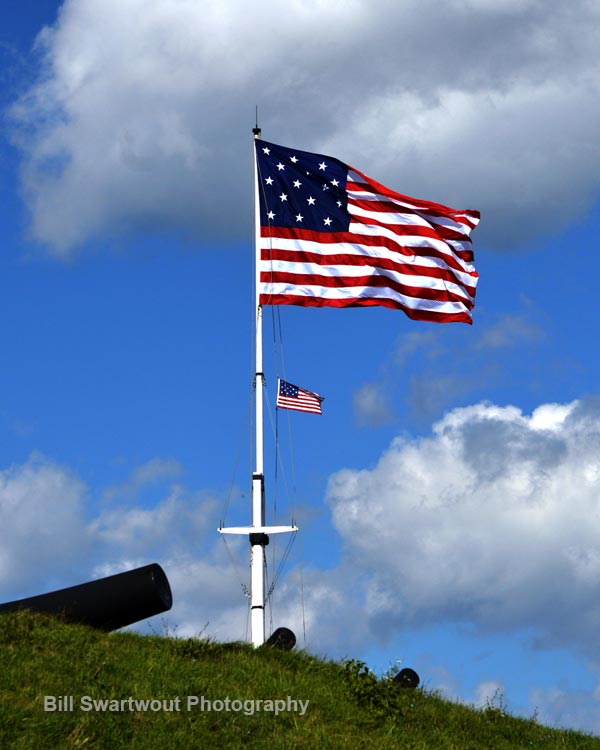
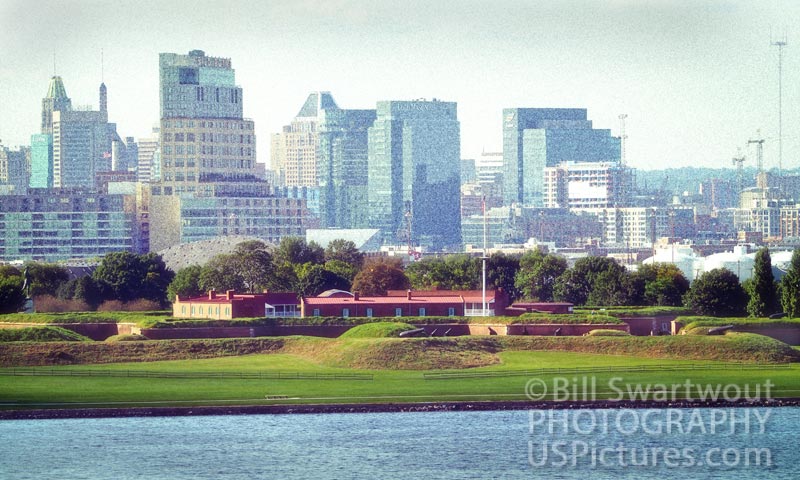
This unique photograph speaks of American History and Patriotism.
So, why are there two American Flags in this photograph? Few people know this, but you can actually fly your own flag over Fort McHenry in Baltimore, Maryland. You can either bring your own American Flag or buy one in the gift shop and take it to a Park Ranger in the fort. He or she will hoist your flag up the historic flagpole (may even let you help) and you can see your own flag flying over Fort McHenry. The Visitor Center staff will then give you a certificate to certify that your flag was flown over Fort McHenry.
Two Flags Over Fort McHenry in Baltimore
It was at this revered place that American soldiers defended our young country against the British fleet during the War of 1812. This final battle took place on September 13-14, 1814 and marked one of the culminating battles of the war.
During that overnight battle is when Francis Scott Key penned his poem entitled “The Star Spangled Banner.” That poem was eventually adopted by President Woodrow Wilson as the standard National Anthem of the United States. But it wasn’t until 1929 that “House Resolution 14” was enacted by Congress naming “The Start Spangled Banner” as the official National Anthem of the United States of America.
Use the links below to browse or shop more of Bill’s photographs of Fort McHenry and the American Flag.
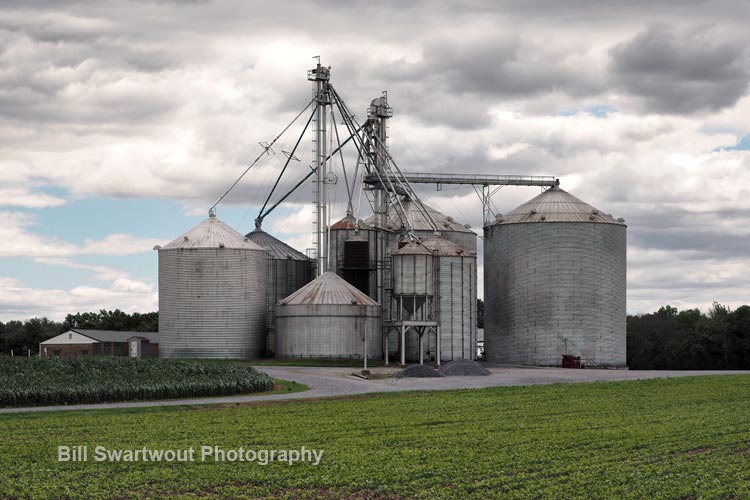
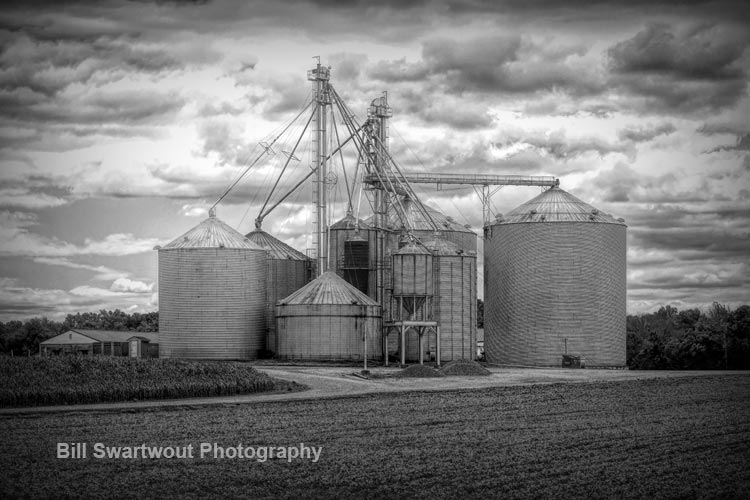
This Delmarva Grain Elevator received positive comments in both presentations, color and B&W.
How does one choose which presentation to publish to one’s online gallery? Why, ask your followers on Social Media, of course – specifically on Facebook.
Delmarva Grain Elevator in Color
The steel-gray color of the sky seems to emulate the steel-color of the silos and transfer screws of this grain elevator on a Maryland farm. When asking friends and followers a piece of art, one must have a thick skin because some of the responses my be quite critical. Fortunately, most in this survey were complimentary.
Delmarva Grain Elevator in Black and White
This was the question – simple and straightforward:
Does this work better in Color or in B&W? (It was also identified as a Delmarva Grain Elevator – photographed on 06/18/22.)
Here is a list of 18 unmodified responses – in the order received:
The color shot is FANTASTIC. !
Color. Love it.
I like the touch of blue in the color version.
Love the color with the blue sky peeking through.
Black and white photography for me, as your subject is mostly monochromatic and lends itself to that medium. The color version almost takes on a selective coloring look to it. But you should always go with what your vision is for the piece, speaking from your heArt.
Color wins…
I personally like the B&W more but it seems that the darkness of the clouds goes away in the above B&W version. I still like the second/B&W version more but would make it a bit darker.
I like the color shot.
Color for sure!
Both great. BW for me.
Color shot!
Black and white, more dramatic.
B & W
Rather ominous in BE. Pop of blue in color is interesting but overall BW
B&W
I like the black and white due to the detailed shown on the structure of the grain silos and transfer screws.
I’m usually a black and white fan but for this one I’ll go with color.
Just enough color in the sky enhances it…my opinion! Great picture!
The overall result is 10 prefer the color presentation and 8 prefer the black and white. While the color version appears to have won the poll, the margin is small, and I would not like to disappoint the 44% of my responders who chose the black and white version of my Delmarva Grain Elevator photograph – so I have uploaded BOTH versions to my online galleries.
Choose a link below to get a better look at YOUR choice…
The Delmarva Peninsula – home to a wide variety of grains, vegetables and livestock – has a long history of farming, but in the 1950s the peninsula began to focus on its poultry industry. Today, Delmarva is one of the most productive agricultural areas in the nation; it is also one of the largest chicken-producing regions in the world. The mainstay diet of a chicken is corn, followed by soybeans, wheat and to a lesser extent, other crops.
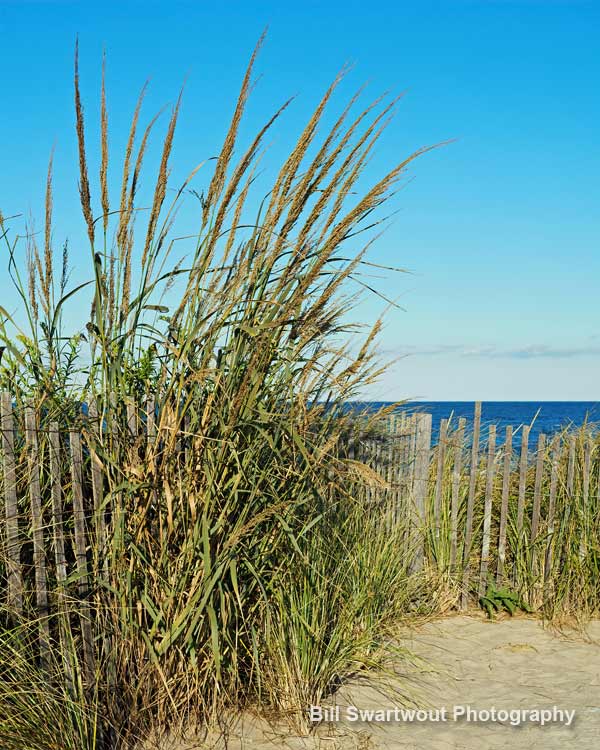
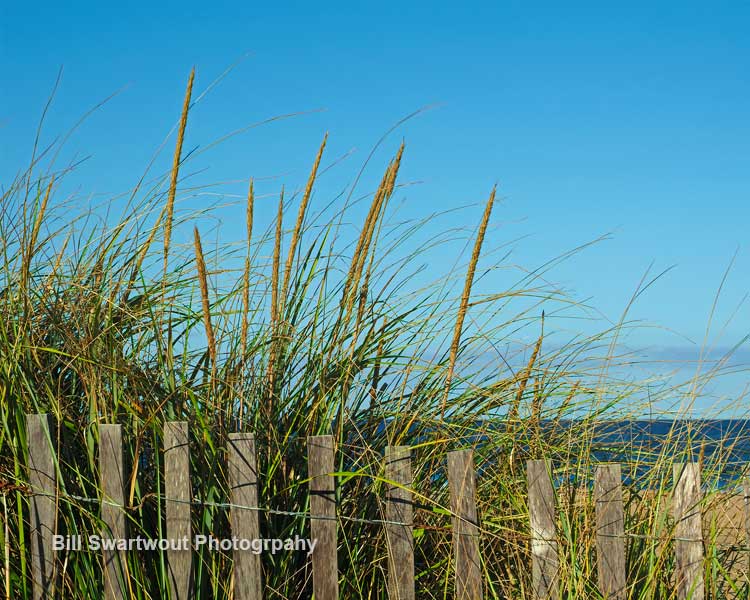
Dunes grasses and fencing are important to our coastal ecosystem.
A sea of grass and sand dunes extend out to the Atlantic Ocean at Bethany Beach in Sussex County, Delaware. This photograph, captured along a beach pathway at Bethany Beach, Delaware, highlights the importance of healthy dune grasses and fence to our coastal ecosystem. These beach grasses and dune fencing help protect the sand dunes and also delineate a pathway to the beach.
Dunes Grasses, Fencing and a Path at Bethany Beach
Bill Swartwout’s photograph of a pathway through the sand dunes at Bethany Beach draws the viewer in to explore the scene.
Bethany Beach, Delaware, is a popular summer destination along the Atlantic coast of the United States. A beautiful beach with no public access road over the dunes, the town relies on dune fences and grasses to direct visitors towards its sandy shore. Some people like to walk along the dunes and look at the grasses and the fence and maybe even imagine what it must have been like before there were people here.
Bethan Beach Dune Grasses and Fence
The very best way to approach photographing a subject is to imagine yourself in conversation with the subject, then moving closer and closer, becoming more of a participant as time goes by. Bill Swartwout’s work is an amazing way to capture the beauty of our natural surroundings, and Crossing the Dunes at Bethany Beach is a wonderful example of that. The photo is tranquil and peaceful, and looks like a scene from a faraway land. It’s an instant favorite!
Thought for the day:If you can’t find joy on the beach, then it’s not the beach that’s wrong.
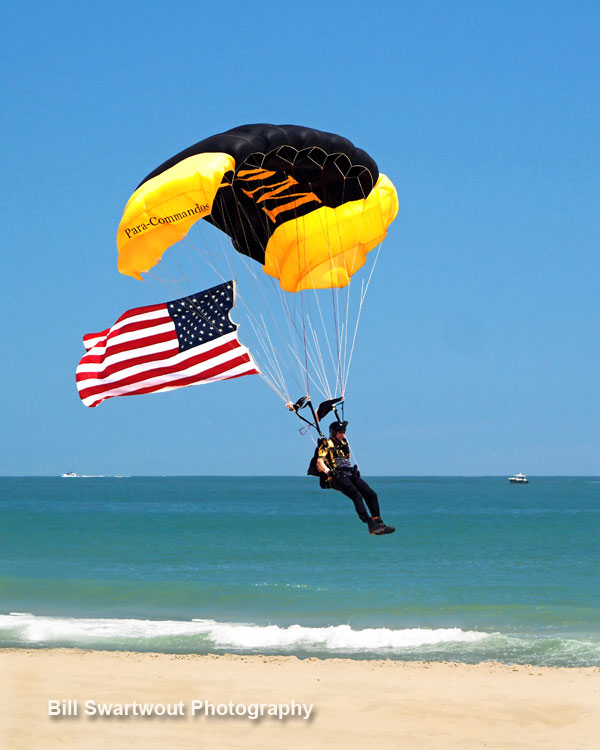
A Para-Commando Parachutist displays the American Flag as he “drops into” the OC Air Show.
Patriotic Beach Landing in Ocean City
During the Ocean City Airshow in June of 2022, parachute jumpers from the United States Special Operations Command (USSOCOM, or SO COM) performed the opening act. They jumped from a helicopter about 8,000 feet above the ocean city beach and landed in the sand near show central at 17th Street on the boardwalk. Show.
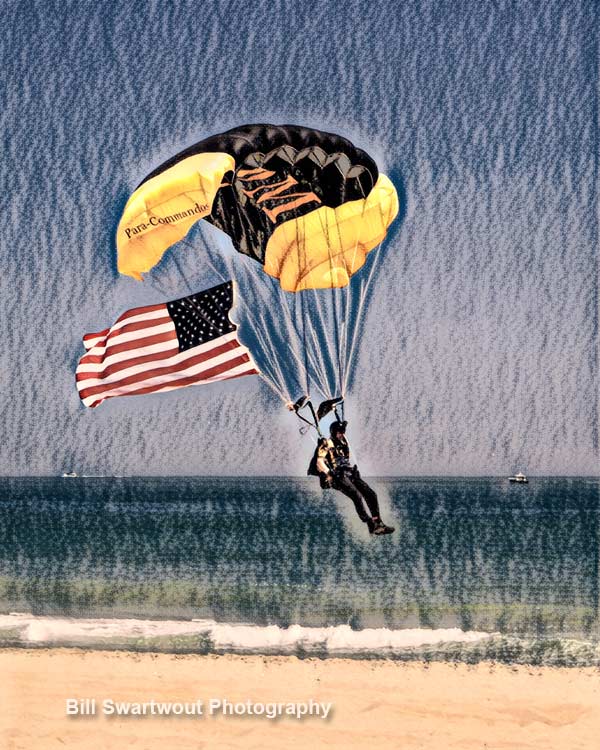
Patriotic Beach Landing in Ocean City as a Simulated Charcoal Sketch
The last of the jumpers flew an American Flag from his rigging and landed to the playing of our National Anthem, the Star Spangled Banner. It was a wonderful way to kick off the OC Air Show and set the stage for three hours of spectacular aerial displays. The event (this year**) was capped off with a rousing performance by the The United States Air Force Thunderbirds demonstration team.
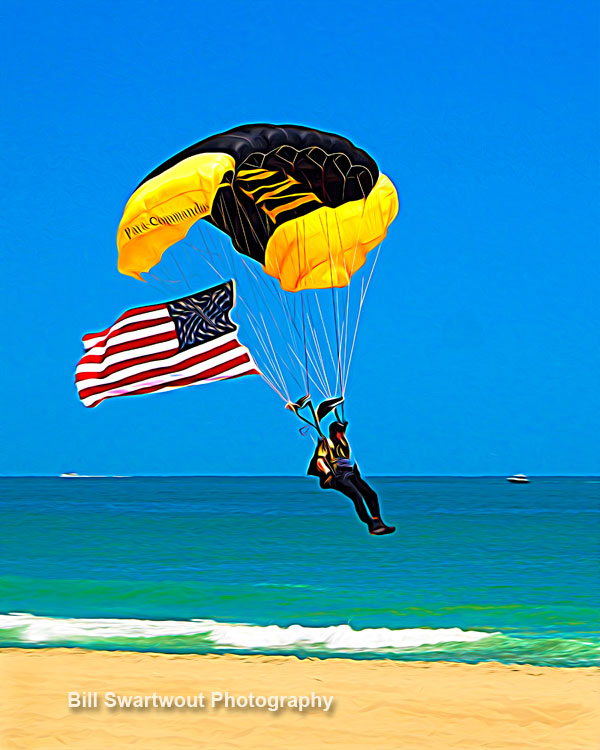
Patriotic Beach Landing in Ocean City in an Abstract Expressionism Presentation
** The Ocean City Airshow usually alternates year-to-year with the Thunderbirds and the United States Navy Blue Angels demonstration team. These are both incredibly powerful displays of the American military and patriotism.
Photographs on a variety of substrates and also on home decor items are available at the links below. Click to shop…
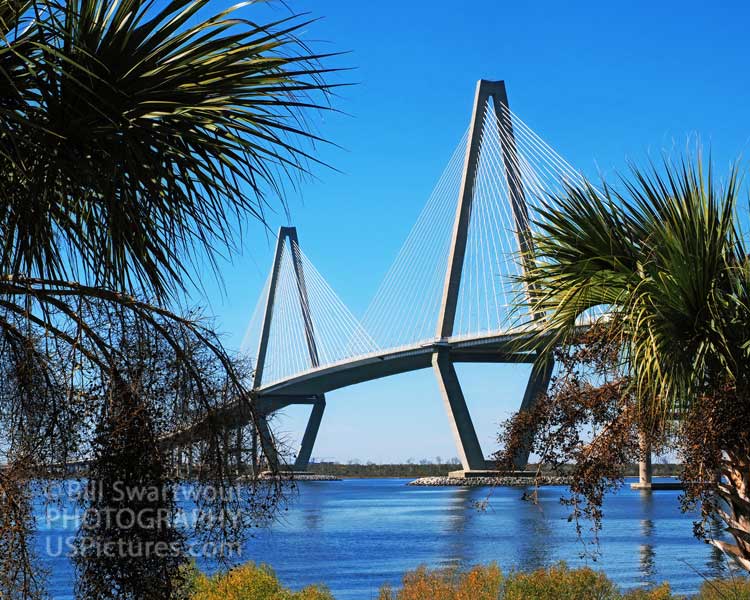
Framed by palm trees, this picturesque bridge photograph will look wonderful in your home or office.
The Arthur Ravenel Jr. Bridge is an architectural wonder. Designed by the renowned firm of Cline Design Associates, this cable-stayed bridge spans the Cooper River and connects Charleston to Mount Pleasant, South Carolina. This bridge was opened on July 16, 2005 and replaced two older bridges, the Silas N. Pearman Bridge and the John P. Grace Memorial Bridge (built in 1929 and 1966).
An architectural wonder, the Arthur Ravenel, Jr. Bridge crosses the Cooper River at Charleston, South Carolina.
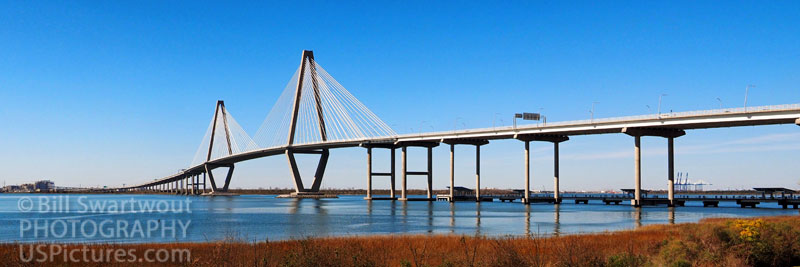
At a total length of 13,200 feet this is the third longest cable-stayed bridge in the western hemisphere with a main span of 1,546 feet and a clearance of 187 feet. In 2006, it won an Outstanding Civil Engineering Achievement award from ASCE for its innovative design and materials. The bridge has eight lanes for vehicular travel and two bicycle/pedestrian lanes so you can see it up close!
Arthur Ravenel Jr. Bridge Panorama Format 3:1
An infrastructure wonder, it is the third longest cable-stayed bridge in the western hemisphere and offers panoramic views that are especially striking at sunset.
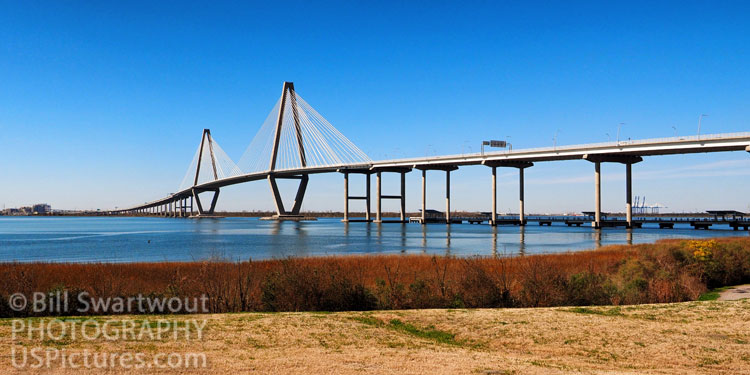
Arthur Ravenel Jr. Bridge Panorama Format 2:1
The Arthur Ravenel, Jr. Bridge (sometimes referred to as the New Cooper River Bridge) is a cable-stayed bridge over the Cooper River in South Carolina. Opened to traffic nearly two decades ago, the 1,546 foot long bridge carries eight travel lanes and two wide outside shoulders. It is held aloft by two 600-foot concrete pylons that support a 650-foot center span and a pair of 350-foot side spans. Total length of the bridge is 13,200 feet or 2.5 miles. With its main span rising only 187 feet above mean high water, the bridge carries Interstate 526 across Charleston Harbor from Patriots Point to U.S. Highway 17 at Mount Pleasant.
The Arthur Ravenel Jr. Bridge is a cable-stayed bridge over the Cooper River in South Carolina, connecting Charleston to Mount Pleasant. It replaced two obsolete cantilever truss bridges. Its eight lanes carry U.S. Highway 17, U.S. Highway 52, and South Carolina Highway 7 as it crosses the river, with a dedicated bicycle and pedestrian lane along the northern side of the bridge.
Imagine if a bridge could talk: “I am the Arthur Ravenel Jr. Bridge in South Carolina, named after a politician who served as state senator and member of the United States House of Representatives. I am a cable-stayed bridge that crosses the Cooper River at Charleston, South Carolina. I opened on July 16, 2005, and was built to replace two aging bridges: one which carried U.S. Route 17 over the Cooper River and another which carried U.S. Route 17 over the Wando River. I connect Charleston to Mount Pleasant, South Carolina.
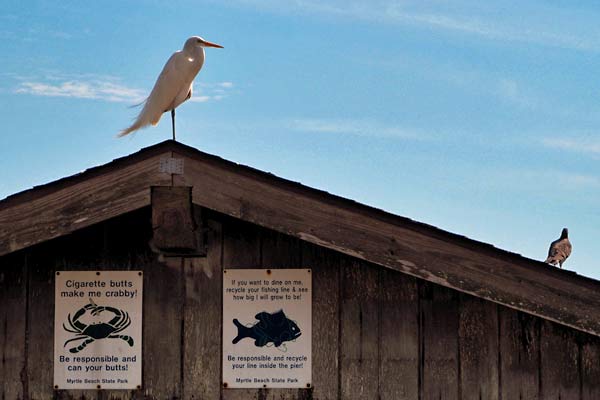
This Egret fishes from the Fishing Pier at Myrtle Beach State Park
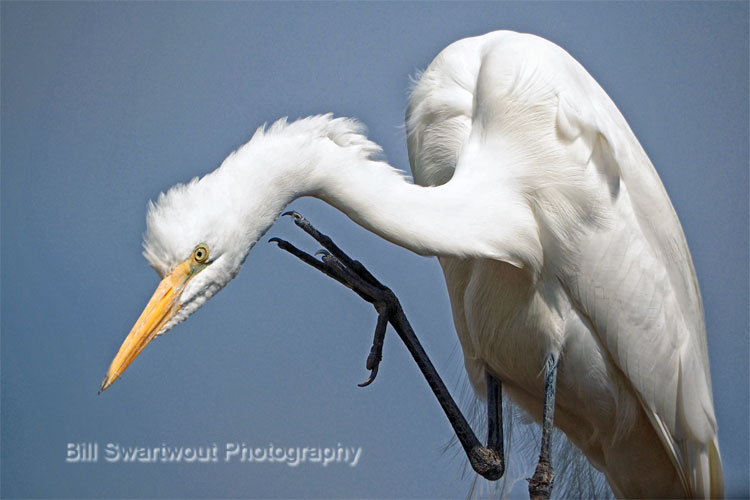
I met Randy, the Great Egret (Ardea alba) , at Myrtle Beach State Park on a recent road trip. He was standing on top of the shelter on the fishing pier and, evidently, had a great itch. The beautiful white plumage and the regal posture of this fascinating bird makes him really stand out in a crowd, so to speak. One cannot help but notice him as he struts around acting so sure of himself.
Randy, the Great Egret at Myrtle Beach State Park, appears to be scratching an itch.
No, I did not name him. A couple of fishermen on the pier told me he hangs around so much they all call him Randy. He keeps an eye on the fishing lines and is quick to react whenever a fish spits out a hook and tries to swim away. Seems like easy picking to me – smart bird.
Randy, the Great Egret, keeps an eye on things from his perch atop the shelter on the fishing pier.
Here’s a picture of Randy, the Great Egret, in an advantageous location on top of the pavilion on the pier. From this vantage point he can keep an eye on everyone and every thing. He seems to trust the fishermen on the pier more that he does the fact that a fish might throw a hook and get away. Randy tries to make sure that nothing “tasty” gets away.
The great egret is also known as the common egret or large egret. It is a wading bird found in both tropical and temperate regions. The great egret is long-legged and long-necked, with a long, thin bill. They are mostly white in color with black tips on their primary feathers. This makes them look almost as if they have been dipped in paint.
The great egrets has been known to live up to 20 years in captivity and up to 30 years in the wild. They feed mostly on fish, frogs, snakes and insects but will also eat reptiles, birds’ eggs and small mammals when needed. Their hunting style is very similar to that of an osprey or an eagle which means they will sit patiently waiting for prey to approach before striking quickly with their long sharp bill which can be up to two feet long!
Great Egrets are monogamous birds meaning they mate for life which usually lasts about 5 years before one dies off leaving behind one chick who will then be cared for by both parents until it reaches maturity at 2 years old when it can fly off into the sunset on its own
While this particular bird was photographed on the fishing pier at Myrtle Beach State Park in South Carolina, this just as easily might be see at any of several fishing piers along the east coast. There are many “Ralphs” just looking for an easy meal. The great egret is also known as the common egret, large egret, or great white egret or even the great white heron.
Photographs of this Great Egret are available at my online stores on a variety of substrates and also on home decor items. Use the links below to shop.
The great white egret is a magnificent bird, with a wingspan that can reach up to seven feet. Its bill is long, thin and black at the tip. It is used for catching fish and insects in shallow water or wetlands. The great white egret has dark legs that are set far back on its body. It has a long neck and head with a large yellow bill.
This bird can be found in North America, Central America and South America as well as Eurasia and Africa. They tend to live near water where they build their nests which are made from sticks or reeds and lined with mud or grasses. A pair of great white egrets may mate for life; however, if one dies then another mate will usually be found soon after this happens during breeding season (March – June). They lay three eggs which hatch after about twenty days depending on temperature levels outside at this time of year (spring). The chicks will fledge after sixty days but continue feeding until about eighty days old when they become independent from their parents once again!
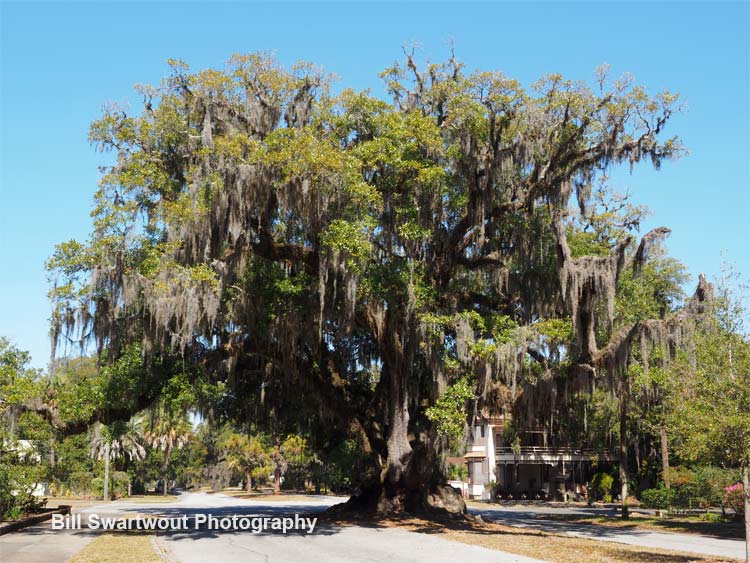
This 900+ year old Southern Live Oak (Quercus virginiana) is a magnificent sight.
When you think of the South, what comes to mind? Is it the sun-drenched fields of cotton and corn? The beautiful live oak trees dripping with Spanish Moss that line the streets and give shade to our homes? Or maybe it’s the charming old homes that fill the towns, or the friendly people who call these places home.
The Lover’s Oak Tree in Brunswick, Georgia
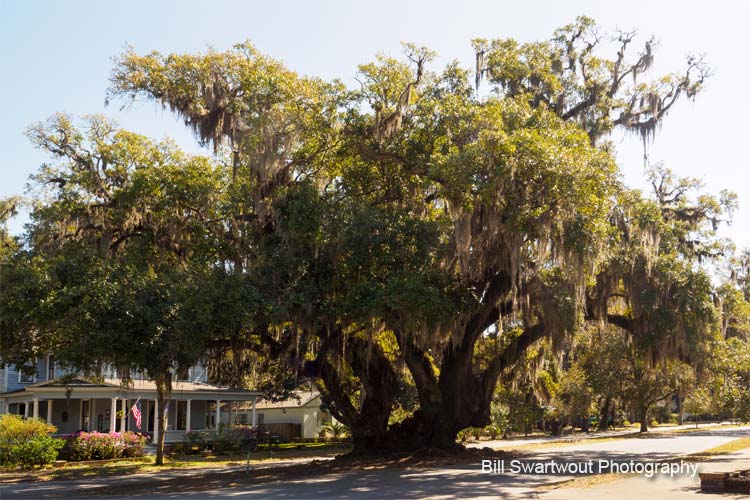
The famous Lover’s Oak Tree in Brunswick, GA rivals the famous Angel Oak on John’s Island near Charleston, South Carolina in size, age and intricate beauty. This wonderous example of a Southern Live Oak is located in the Old Town Historic District of Brunswick, GA at the intersection of Albany and Prince Streets.
The name of “Lover’s Oak” is derived from a local historic legend**. Evidently, Native American braves met with their maidens under the majestic limbs of this enormous tree.
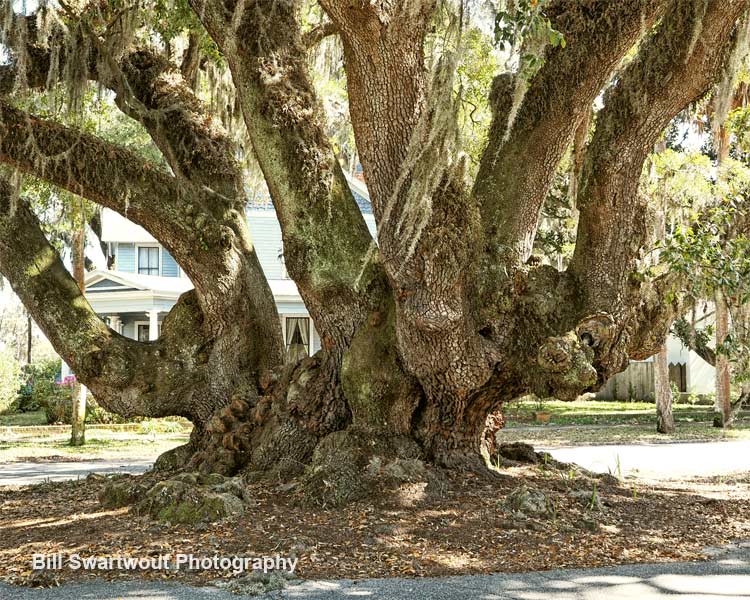
Southern Live Oak (Quercus virginiana), the Lover’s Oak in the Historic District of Brunswick, GA.
The Southern Live Oak is known for growing outward as much as growing upward. Often the breadth, or width, of the tree is a good bit greater than the height.
The Lover’s Oak in Brunswick, Georgia is estimated to have been here long before this country was “discovered” by the Old World explorers (dare we mention the name Christopher Columbus?). The trunk has a diameter of 13 feet and that branches into 10 limbs, each being between 12 and 30 inches in diameter.
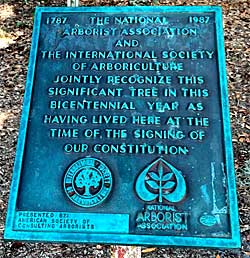
An informational plaque at the Lover’s Oak reads: “The National Arborist Association and The International Society of Arboriculture jointly recognize this significant tree in this bicentennial year as having lived here at the time of the signing of our constitution.”
** Another legend has it that this tree is where two young lovers were caught kissing by their parents and cast out into the cold. The couple was so distraught by their separation that they committed suicide by hanging themselves from the branches of this very tree. It is said that if you stand beneath its branches at midnight on any Friday night, you’ll hear the cries of their spirits as they search for one another.
Use the links below to see more of these images and how they look on different wall art substrates. There are prints, framed prints, canvas presentations, acrylic and more.