Angel Oak Tree in South Carolina

This iconic tree is located on St. John’s Island just south of Charleston, SC

Tucked away in the heart of South Carolina’s picturesque Lowcountry, stands the ancient and awe-inspiring Angel Oak Tree. With its sprawling branches, some reaching up to 65 feet, and a canopy that spans over 17,000 square feet, this natural wonder is believed to be over 400 years old. The tree’s enduring presence evokes a sense of serenity and timelessness, inviting visitors to experience an unparalleled connection with nature.
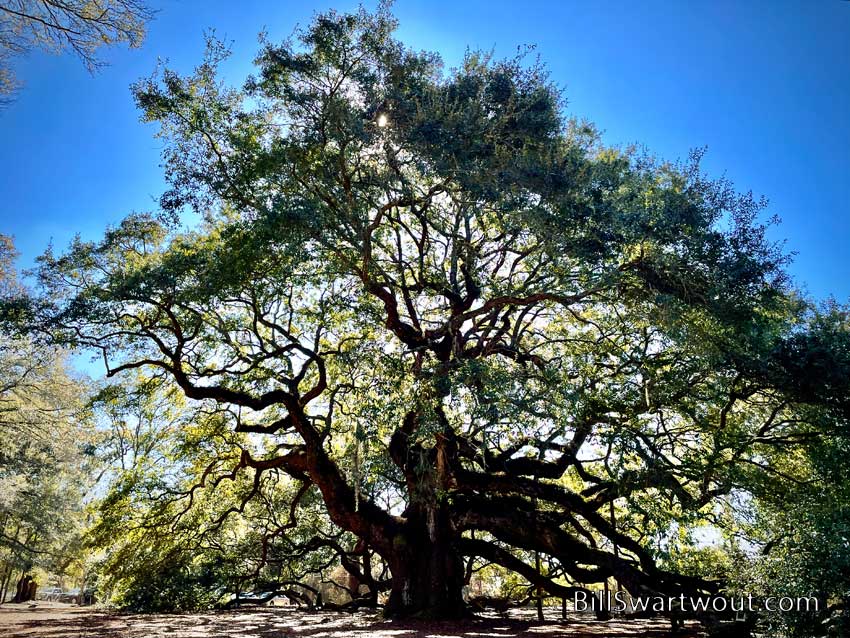
The Angel Oak as seen backlit on a sunny day, which emphasizes its immense structure.

As one gazes upon the Angel Oak Tree, it becomes evident that this magnificent specimen has stood witness to centuries of history and change. Its gnarled limbs seem to tell stories of resilience and growth, offering a tangible link to the past while inspiring contemplation about the future. Surrounded by lush greenery and resonant with tranquility, this sacred site serves as a poignant reminder of nature’s enduring beauty and significance in our lives. Whether you are a nature enthusiast or simply seeking solace in the midst of modern chaos, the Angel Oak Tree promises an unforgettable encounter that transcends time and captures the essence of South Carolina’s natural splendor.

History of Angel Oak Tree

The Angel Oak is a majestic natural wonder with a rich and intriguing history. Believed to be around 400-500 years old, this sprawling live oak has stood witness to centuries of events and changes in the surrounding environment. Named after the estate of Justus Angel, who once owned the land where it grows, the tree has become an iconic symbol of resilience and endurance.

Visitors are often struck by the awe-inspiring presence of the Angel Oak Tree, its massive limbs stretching out like ancient guardians embracing all who come near. The significance of this living monument goes beyond its physical beauty; it serves as a reminder of our deep connection to nature and our shared history. From Native American legends to European settlers’ tales, the tree embodies a tapestry of cultural narratives that have shaped the region over time. Whether you’re drawn to its soothing shade or its remarkable survival against natural disasters and development pressures, there’s something undeniably captivating about the Angel Oak Tree’s enduring legacy.

Characteristics and significance

The Angel Oak Tree, located near Charleston, SC, stands as a testament to the enduring characteristics of strength and resilience. Its massive limbs stretch outwards, offering shade and sanctuary for countless visitors who come to marvel at its magnificence. The tree’s longevity, estimated at over 400 years old, serves as a powerful symbol of timelessness and endurance in the face of adversity.

Moreover, the significance of the Angel Oak Tree extends beyond its physical presence; it embodies a deep connection to history and nature. As one stands in awe beneath its sprawling branches, there is a profound sense of reverence for the interconnectedness of all life on earth. The tree evokes a feeling of humility and respect for the natural world, reminding us of our place within it and inspiring an appreciation for the beauty and wisdom that can be found in even the oldest living organisms.

Visitors and tourism

Visitors and tourism play a vital role in the preservation and promotion of natural wonders like the Angel Oak Tree near Charleston, South Carolina. The influx of tourists not only brings economic benefits to the local community but also raises awareness about the significance of protecting these natural treasures. Moreover, visitors have the opportunity to learn about the history and cultural importance of the Angel Oak Tree, fostering a deeper appreciation for nature.

Tourism also creates an opportunity for cultural exchange and understanding as people from various backgrounds come together to experience this remarkable attraction. Additionally, by attracting attention from around the world, tourism can encourage greater investment in conservation efforts to safeguard such iconic landmarks for future generations. Overall, visitors can contribute positively to the sustainability and protection of places like the Angel Oak Tree through their engagement with responsible tourism practices and support for environmental initiatives.

Conservation efforts
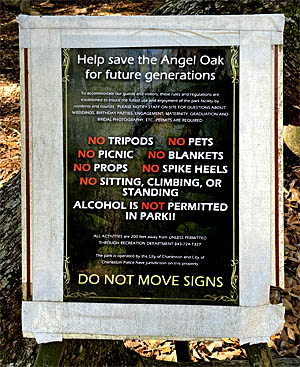
Angel Oak signage to help preserve the tree.

Conservation efforts around the world are crucial for preserving natural wonders like the Angel Oak. With 400,000+ visitors every year, the sustained popularity of this iconic tree has led to increased foot traffic and potential damage to its delicate ecosystem. In response, conservationists have implemented measures to protect the Angel Oak Tree, such as controlled visitation hours, ample signage, and educational programs to promote responsible tourism.

Moreover, collaborative partnerships between local communities and environmental organizations have further bolstered these efforts. By engaging with residents and visitors alike, these initiatives seek to foster a deeper appreciation for nature while emphasizing the importance of sustainable practices. Overall, championing conservation efforts not only safeguards treasured landmarks but also cultivates a legacy of environmental stewardship for future generations to embrace and uphold.

Local legends and myths

Local legends and myths have long been associated with the Angel Oak Tree. One of the most popular legends is that the tree is named after an 18th-century ghost known as the Angel of Bethesda, who supposedly haunts its branches. Some locals also believe that the tree is inhabited by protective spirits that watch over all who visit it. These stories have contributed to the mystical aura surrounding the Angel Oak, adding a layer of intrigue to its already impressive presence.

In addition to these supernatural tales, there are also local myths about the origin and age of the tree. While scientists estimate its age to be around 400-500 years old, many legends claim it to be much older, attributing its existence to divine or mythical origins. These myths serve not only as folklore but also as a testament to the deep reverence and awe inspired by this magnificent natural wonder in South Carolina.

Preserving this natural wonder

In conclusion, the preservation of the Angel Oak in the South Carolina Low Country is not just a matter of environmental conservation but also a testament to our appreciation for natural wonders. This majestic oak stands as a symbol of resilience and endurance in the face of urbanization and climate change. Preserving this natural wonder not only ensures the survival of a unique species but also provides an opportunity for future generations to connect with nature in its purest form.
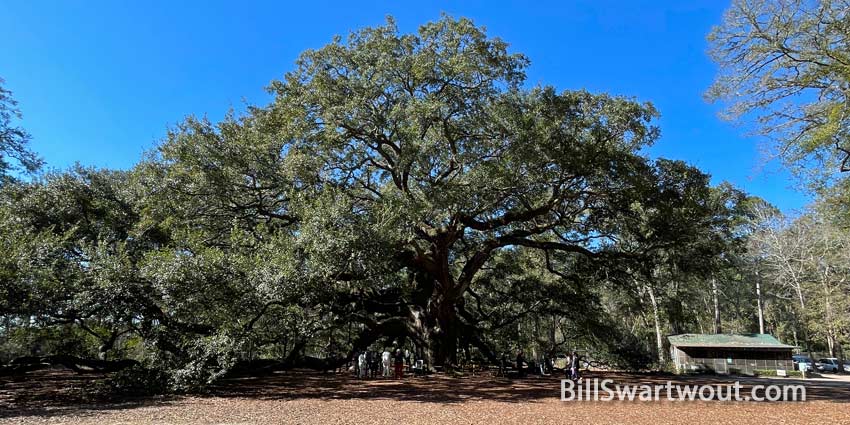
Angel Oak Tree from afar to give an idea of how far across the branches reach.

Furthermore, by protecting the Angel Oak Tree, we uphold our commitment to biodiversity and ecological balance. The tree provides habitat for various organisms, contributes to air quality, and adds irreplaceable beauty to the landscape. Its preservation also serves as a reminder that small acts can make a big difference – from supporting local conservation efforts to advocating for sustainable development practices. In essence, preserving this natural wonder is an investment in both the present and future well-being of our planet and all its inhabitants.

Visit Angel Oak Park

Location: 3688 Angel Oak Rd, Johns Island, SC 29455

Links to see more wall art

Browse and/or purchase by clicking a link below.

Link: Angel Oak Sunny Glow
Link: Angel Oak Tree Casting Shadows
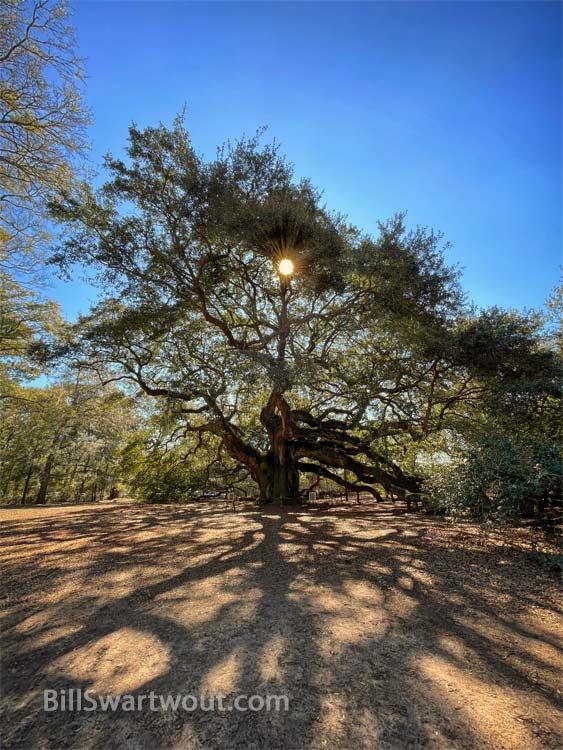
The majestic Angel Oak tree stands as a symbol of endurance and natural beauty, casting its intricate shadows on the ground below.

Visiting Myrtle Beach for the Winter.

It’s usually a good bit warmer here than back home in Delaware.

So, you’ve decided to join the flock of snowbirds and head down to Myrtle Beach in January. You might be thinking, Am I crazy? Isn’t it cold down there? Well, I’m here to tell you that while the rest of the country is shivering, Myrtle Beach is enjoying some surprisingly warmer weather. It’s like a secret paradise for those seeking refuge from the icy grip of winter.

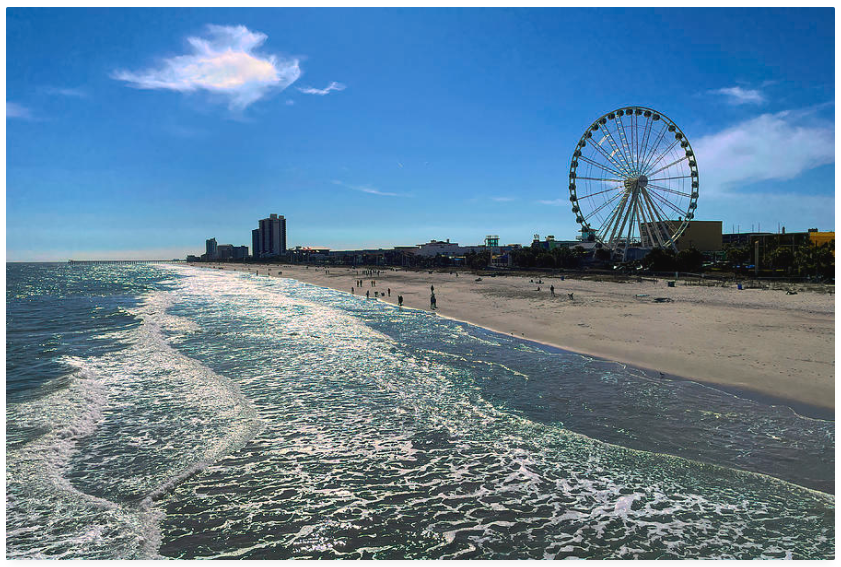
The beach at Myrtle Beach looking south from the 14th Street Pier. The pier in the distance is the 2nd Street Pier.

But don’t think that a trip to Myrtle Beach in February will be your typical winter escape. Sure, it may not be as hot as midsummer, but you’ll still find plenty of sunshine and outdoor activities to keep you entertained. From beach walks with your toes in the sand to golfing on world-class courses, there’s no shortage of ways to enjoy the milder temperatures and take advantage of fewer crowds. February is like that one friend who always has an extra sweater handy – surprisingly warmer than expected.

When March rolls around, you’ll feel like you’ve hit the jackpot with even more pleasant weather. The ocean breeze becomes gentle and inviting—a perfect backdrop for leisurely strolls along the boardwalk or sipping cocktails at beachside bars. Plus, you can catch some early spring events and festivals without worrying about battling through summer throngs just yet. So pack your bags, snowbird! Myrtle Beach is waiting for you with open arms and warmer temperatures than you’d ever expect during these off-season months!

Be sure to visit Bill’s Myrtle Beach Collection: CLICK HERE.


Visiting Myrtle Beach, South Carolina?

Here are two online sources that you may find useful for your vacation.

Myrtle Beach, SC is a great place to visit for a family vacation. With its beautiful beaches and plenty of things to do, it’s easy to see why this destination has become so popular. If you’re planning a trip to Myrtle Beach and want to get the most out of your experience, here are two online resources that can help you make the most of your visit.

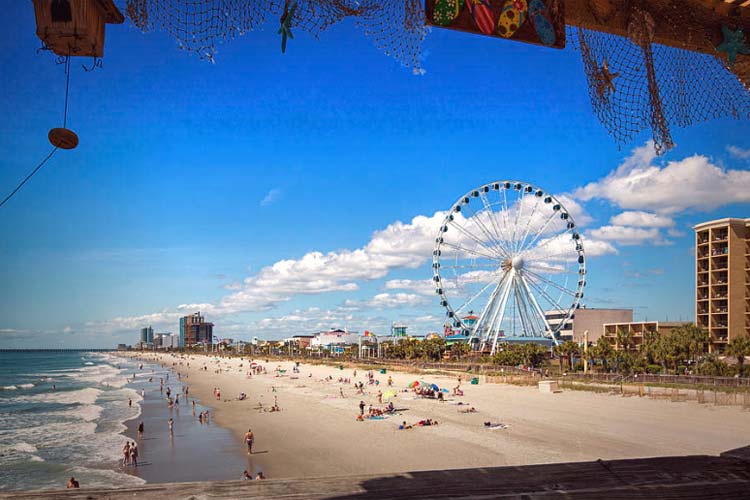
the beach and skywheel myrtle beach
The beach and Skywheel as seen from the 14th Street Pier in Myrtle Beach, SC

Myrtle Beach On The Cheap

Myrtle Beach, South Carolina has long been a popular vacation spot for beachgoers looking to relax and enjoy the ocean views. But with record numbers of people flocking to the area each year, it can be hard to find affordable lodging and activities that don’t break the bank. Thankfully, there is now an online resource that can help travelers experience Myrtle Beach without breaking their budget.

The website, aptly called Myrtle Beach on the Cheap, is maintained by a long-time local who knows all the best places to go for maximum fun at minimum cost. From discounts on golf courses and water parks to free attractions like local museums and parks, visitors will find a wealth of information on ways they can save money while exploring this charming coastal town.

Website image of Myrtle Beach on the Cheap.

Myrtle Beach, South Carolina is known for its bustling boardwalks, expansive beaches, and thrilling attractions. But if you’re looking to enjoy this coastal town without breaking the bank, there’s an online resource that can help. The website MyrtleBeachOnTheCheap.com is designed specifically to help visitors find affordable ways to explore the area.

From discounted tickets at popular attractions like Ripley’s Aquarium and Hard Rock Cafe to free activities like beach yoga classes in North Myrtle Beach and outdoor movie screenings along Broadway at the Beach, this website has something for everyone on a budget. It even features daily deals from local businesses such as restaurants, shopping outlets and entertainment venues so visitors can save money while they explore the city’s vibrant nightlife scene.

Macaroni KID Myrtle Beach, SC

Macaroni KID Myrtle Beach, SC is an online resource for parents and families who live in or are visiting the area. The website is also maintained by a Myrtle Beach local and offers a plethora of activities and events that parents can take advantage of with their children. From school events to fun outings on the weekends, Macaroni Kid has it all to make your stay in Myrtle Beach memorable for young ones and adults alike!

The website provides its users with weekly newsletters filled with local stories, hot deals, activities, and freebies. Contests are even being planned for the near future. User reviews can be found across the site to ensure that customers have a great experience wherever they choose to go. With easy navigation through the site’s home page and comprehensive information about each activity listed, Macaroni Kid truly serves as an invaluable resource when planning family trips or just finding something new to do in town.

Website image of Macaroni Kid Myrtle Beach
Website image of Macaroni KID Myrtle Beach

Macaroni KID Myrtle Beach is free to join, making it easier than ever before for families with children to find out about interesting things happening in their community. This comprehensive online source covers everything from local museum exhibits and music festivals to educational programs and family-friendly attractions. Additionally, seasonal offerings like beach parties and holiday activities are included in its expansive list of events. With Macaroni KID Myrtle Beach’s help, parents can quickly discover the best ways to keep their little ones entertained while learning something new along the way.


Here’s where to fine these helpful resources…

Link to: Myrtle Beach on the Cheap

Link to: Macaroni KID Myrtle Beach


Arthur Ravenel Jr. Bridge Wall Art

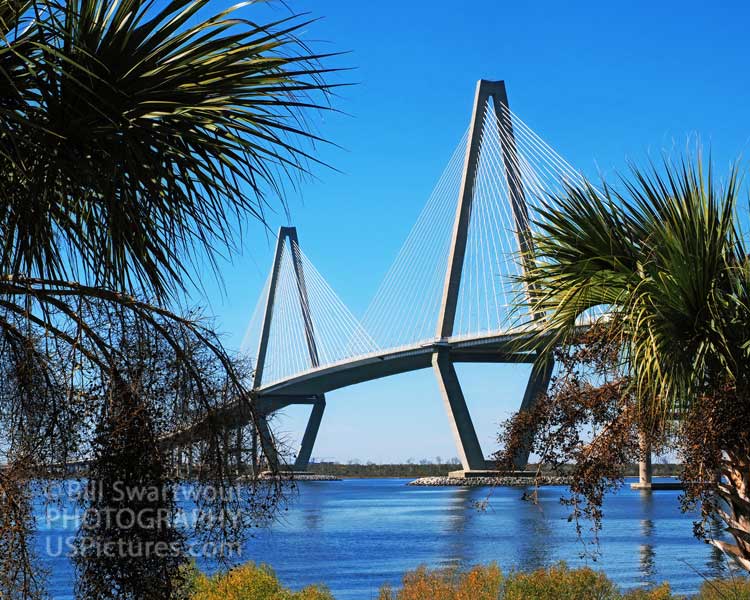
Framed by palm trees, this picturesque bridge photograph will look wonderful in your home or office.

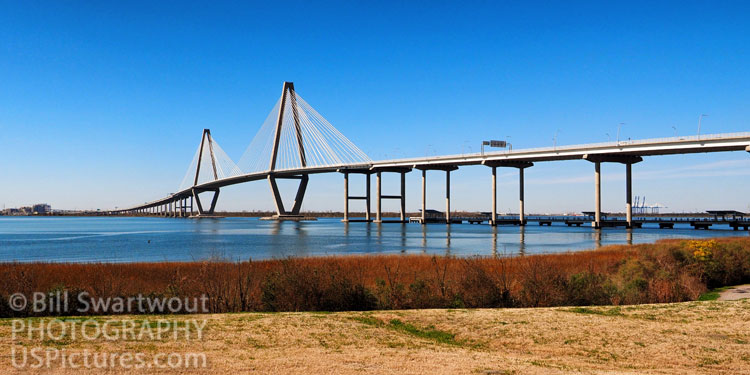
The Arthur Ravenel Jr. Bridge is an architectural wonder. Designed by the renowned firm of Cline Design Associates, this cable-stayed bridge spans the Cooper River and connects Charleston to Mount Pleasant, South Carolina. This bridge was opened on July 16, 2005 and replaced two older bridges, the Silas N. Pearman Bridge and the John P. Grace Memorial Bridge (built in 1929 and 1966).

Arthur Ravenel Jr. Bridge, Charleston, SC
An architectural wonder, the Arthur Ravenel, Jr. Bridge crosses the Cooper River at Charleston, South Carolina.

At a total length of 13,200 feet this is the third longest cable-stayed bridge in the western hemisphere with a main span of 1,546 feet and a clearance of 187 feet. In 2006, it won an Outstanding Civil Engineering Achievement award from ASCE for its innovative design and materials. The bridge has eight lanes for vehicular travel and two bicycle/pedestrian lanes so you can see it up close!

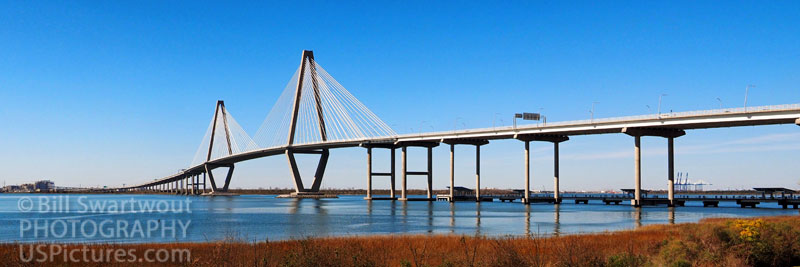
Arthur Ravenel Jr. Bridge Panorama Format
Arthur Ravenel Jr. Bridge Panorama Format 3:1

An infrastructure wonder, it is the third longest cable-stayed bridge in the western hemisphere and offers panoramic views that are especially striking at sunset.

Arthur Ravenel Jr. Bridge Panorama Format 2
Arthur Ravenel Jr. Bridge Panorama Format 2:1


The Arthur Ravenel, Jr. Bridge (sometimes referred to as the New Cooper River Bridge) is a cable-stayed bridge over the Cooper River in South Carolina. Opened to traffic nearly two decades ago, the 1,546 foot long bridge carries eight travel lanes and two wide outside shoulders. It is held aloft by two 600-foot concrete pylons that support a 650-foot center span and a pair of 350-foot side spans. Total length of the bridge is 13,200 feet or 2.5 miles. With its main span rising only 187 feet above mean high water, the bridge carries Interstate 526 across Charleston Harbor from Patriots Point to U.S. Highway 17 at Mount Pleasant.


The Arthur Ravenel Jr. Bridge is a cable-stayed bridge over the Cooper River in South Carolina, connecting Charleston to Mount Pleasant. It replaced two obsolete cantilever truss bridges. Its eight lanes carry U.S. Highway 17, U.S. Highway 52, and South Carolina Highway 7 as it crosses the river, with a dedicated bicycle and pedestrian lane along the northern side of the bridge.


Imagine if a bridge could talk: “I am the Arthur Ravenel Jr. Bridge in South Carolina, named after a politician who served as state senator and member of the United States House of Representatives. I am a cable-stayed bridge that crosses the Cooper River at Charleston, South Carolina. I opened on July 16, 2005, and was built to replace two aging bridges: one which carried U.S. Route 17 over the Cooper River and another which carried U.S. Route 17 over the Wando River. I connect Charleston to Mount Pleasant, South Carolina.

Link: Arthur Ravenel Jr. Bridge in the Palms (free shipping)

Link: Arthur Ravenel Jr. Bridge Panorama Format 3:1 (free shipping)

Link: Arthur Ravenel Jr. Bridge Panorama Format 2:1 (free shipping)

Link to: Bill’s Pictorem Gallery

Link to: Bill’s FineArtAmerica/Pixels Gallery

Great Egret Scratching an Itch

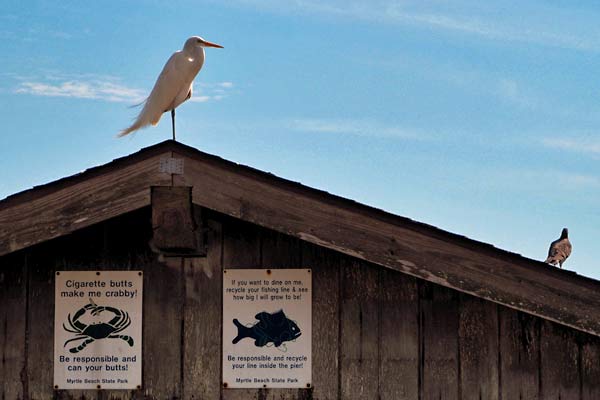
This Egret fishes from the Fishing Pier at Myrtle Beach State Park

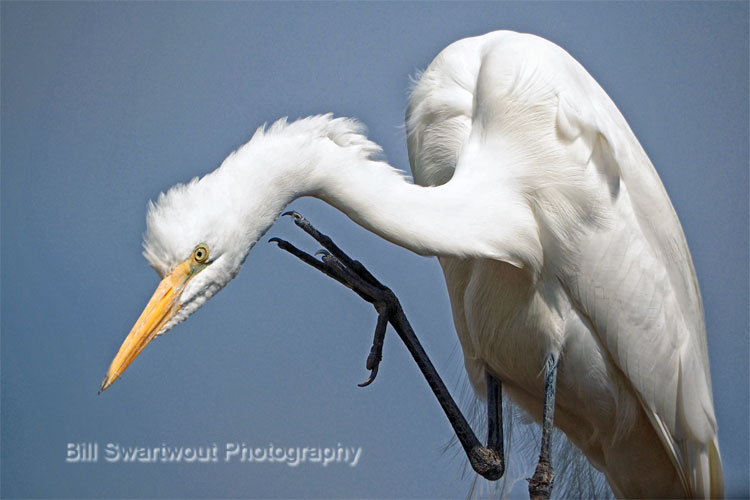
I met Randy, the Great Egret (Ardea alba) , at Myrtle Beach State Park on a recent road trip. He was standing on top of the shelter on the fishing pier and, evidently, had a great itch. The beautiful white plumage and the regal posture of this fascinating bird makes him really stand out in a crowd, so to speak. One cannot help but notice him as he struts around acting so sure of himself.

gret egret scratching an itch
Randy, the Great Egret at Myrtle Beach State Park, appears to be scratching an itch.

No, I did not name him. A couple of fishermen on the pier told me he hangs around so much they all call him Randy. He keeps an eye on the fishing lines and is quick to react whenever a fish spits out a hook and tries to swim away. Seems like easy picking to me – smart bird.

great egret on roof on fishing pier
Randy, the Great Egret, keeps an eye on things from his perch atop the shelter on the fishing pier.

Here’s a picture of Randy, the Great Egret, in an advantageous location on top of the pavilion on the pier. From this vantage point he can keep an eye on everyone and every thing. He seems to trust the fishermen on the pier more that he does the fact that a fish might throw a hook and get away. Randy tries to make sure that nothing “tasty” gets away.

The great egret is also known as the common egret or large egret. It is a wading bird found in both tropical and temperate regions. The great egret is long-legged and long-necked, with a long, thin bill. They are mostly white in color with black tips on their primary feathers. This makes them look almost as if they have been dipped in paint.

The great egrets has been known to live up to 20 years in captivity and up to 30 years in the wild. They feed mostly on fish, frogs, snakes and insects but will also eat reptiles, birds’ eggs and small mammals when needed. Their hunting style is very similar to that of an osprey or an eagle which means they will sit patiently waiting for prey to approach before striking quickly with their long sharp bill which can be up to two feet long!

Great Egrets are monogamous birds meaning they mate for life which usually lasts about 5 years before one dies off leaving behind one chick who will then be cared for by both parents until it reaches maturity at 2 years old when it can fly off into the sunset on its own

While this particular bird was photographed on the fishing pier at Myrtle Beach State Park in South Carolina, this just as easily might be see at any of several fishing piers along the east coast. There are many “Ralphs” just looking for an easy meal. The great egret is also known as the common egret, large egret, or great white egret or even the great white heron.

Photographs of this Great Egret are available at my online stores on a variety of substrates and also on home decor items. Use the links below to shop.

Link to: Egret Scratching an Itch at Bill’s FineArtAmerica/Pixels Store.

Link to: Bill’s Full Fine Art America/Pixels Gallery

The great white egret is a magnificent bird, with a wingspan that can reach up to seven feet. Its bill is long, thin and black at the tip. It is used for catching fish and insects in shallow water or wetlands. The great white egret has dark legs that are set far back on its body. It has a long neck and head with a large yellow bill.

This bird can be found in North America, Central America and South America as well as Eurasia and Africa. They tend to live near water where they build their nests which are made from sticks or reeds and lined with mud or grasses. A pair of great white egrets may mate for life; however, if one dies then another mate will usually be found soon after this happens during breeding season (March – June). They lay three eggs which hatch after about twenty days depending on temperature levels outside at this time of year (spring). The chicks will fledge after sixty days but continue feeding until about eighty days old when they become independent from their parents once again!


Waccamaw Coast Line Railroad Tracks & Ties

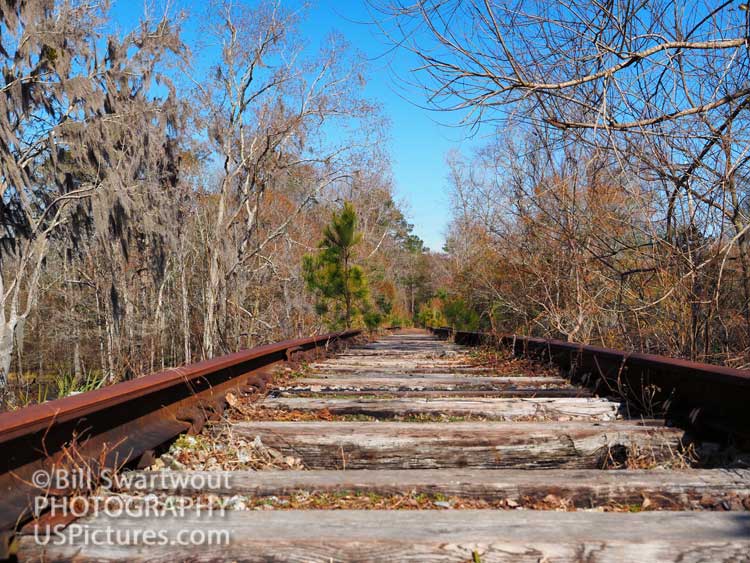
The the remaining tracks of an abandoned railroad make for interesting scenery.

The Waccamaw Coast Line Railroad use to carry passengers and freight from Conway to Myrtle Beach. The line has been abandoned since the 1990’s but the remaining tracks make for interesting scenery. The old railroad bridge cannot be seen in this particular view but it’s out there. You can visit this scene while walking the Riverwalk along the Waccamaw River as it flows through Conway, South Carolina.

Waccamaw Coast Line Railroad Abandoned Tracks

The next time I am in Conway, I plan to hike along this old railbed to cross the river and photograph the old swing-bridge. The photograph below is in black and white which helps bring out the texture of the decaying railroad ties and the overgrowth of trees and brush that is reclaiming this thoroughfare – taking it back to nature.

Waccamaw Coast Line Railroad Abandoned Tracks Monochrome
Waccamaw Coast Line Railroad Abandoned Tracks in Black and White

Use the links below to see more of these images and how they look on different wall art substrates. There are prints, framed prints, canvas presentations, acrylic and more.

Link: Waccamaw Coast Line Railroad Abandoned Tracks

Link: Waccamaw Coast Line Railroad Abandoned Tracks Monochrome

Link to: Bill’s full Pictorem Gallery

Link to: Bill’s full Fine Art American Gallery

Little information remains about the Waccamaw CoastLine Railroad. I could find only bits and pieces of information and one mention of abandoned trackage. The Atlantic Coast Line served this line when it was first constructed by the Waccamaw, Conway & Aynor Railway between 1916 and late 1919 to serve lumber and naval stores traffic. It was then acquired by the ACL in December 1919 and became an extension of the Myrtle Beach Branch. The line survived as a freight only branch until the early 1980’s when passenger service was briefly revived with various excursion trains operated by Inland Rail Tours. At some point the name was changed to Waccamaw Coast Line – probably around 1987 but service continued for only a short time and was discontinued in the early 1990’s.

Overall, the WCL RR was an obscure experiment in intrastate railroading that didn’t last all that long. But at least it had a good run while it lasted, even if only a handful of people were aware of its existence and, that, is what may have been what caused its demise.

Waccamaw River at Conway South Carolina

An idyllic river scene like this can be found along the Riverwalk at Conway.

The Waccamaw River begins its 140 mile trek toward the sea from Lake Waccamaw in North Carolina to Winyah Bay, an estuary that connects with the Atlantic Ocean near Georgetown, South Carolina. About half way along its journey it flows through Horry County and the City of Conway, SC where this photograph was taken. The river is wide and deep enough to be navigable and was once a watery thoroughfare for steamboats.

Waccamaw River in Conley South Carolina

Factoid: The first steamboat to ply the waters of the Waccamaw River was a Confederate troop ship, the Francis Marion.

Black and White waterscape scenes are often quite striking as wall art in the right home decor setting. What do you think – do you like this Black and White presentation?) Please leave a comment below.)

Waccamaw River in Conley South Carolina in Black and White

Yadda

Use the links below to see these images as wall art on a variety of substrates, one of which may just attract your interest.

Link: Waccamaw River in Conway South Carolina

Link: Waccamaw River at Conway in Black and White

Link to: Bill’s full Pictorem Gallery

Link to: Bills Fine Art America Gallery

The Waccamaw, along with the Great Pee Dee, Little Pee Dee and Little Rivers, all served as important transportation routes for Horry County, South Carolina. For Native Americans and early settlers alike, the rivers of this geographic area were essentially the Interstate Highways of today. This area was fortunate to have a navigable river system because it provided Horry County, Conway and environs easy access to the world beyond.

The era of steamboats on the Waccamaw faded about 1920 or so. However the river remains a vibrant natural resource part of the environment and maintains its beauty for people today to enjoy visually and recreationally. You can see vistas like this when strolling along the famous Riverwalk along the riverside in Conway.

Lurking in the Marsh at Murrells Inlet South Carolina

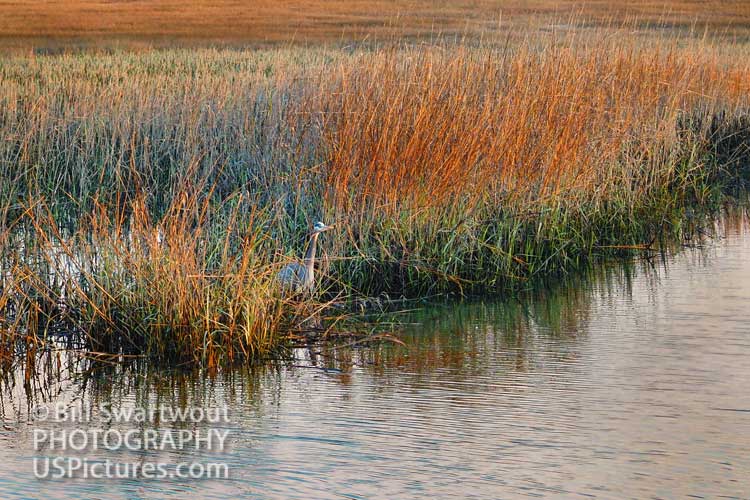
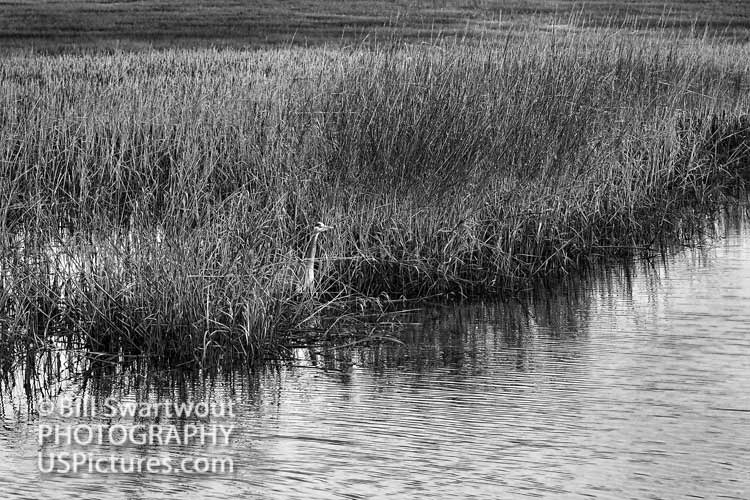
A Great Blue Heron hides among the marsh grasses fishing for a meal.

Fishing is a way of life in Murrells Inlet, and not just for those make their living at it. Fishing, both within the creek and in the ocean is a part of the history, a bond with the place and even among the inhabitants – both the humans and the lesser beasts and critters.

Marsh Grasses and a Great Blue Heron at Murrells Inlet in South Carolina

As the fishing depends on the fish, so the fish depend on the marsh and the entire ecosystem. This symbiotic relationship gives rise to some beautiful and unique scenery – that often looks as good in black and white as it does in full color.

Lurking in the March at Murrells Inlet
Lurking in the March at Murrells Inlet in Black and White

From the time of its formation about 6,000 years ago, the Murrells
Inlet saltmarsh has been a source of food for local inhabitants. Native
Americans depended on the marsh for the seasonal provision of clams,
oysters, and fish, a tradition which persisted through colonial and
plantation times, and continues today. In the 20th century, recreational
and commercial fishing broadened and increased local dependence
upon the marsh.

Click the links below to see the wall art substrates available for these photographs.

Link: Lurking in the Marsh at Murrells Inlet SC

Link: Lurking in the Marsh at Murrells Inlet Monochrome

Link to: Bill’s full Gallery at Pictorem

Link to: Bill’s Gallery hosted by Fine Art America

Saltmarshes like Murrells Inlet provide a rich and sheltered habitat for
fish, from baitfish like Mummichog and striped mullet on up to gamefish of the nearshore ocean, such as grouper. (Just naming two of many examples here.) This is because of the abundance and variety of food available within the marsh, and the relative absence of large predators (that Blue Heron notwithstanding). Scientists have found that more than 75 percent of nearshore ocean fish use the marsh at some stage of their life-cycle, for spawning, for juvenile growth and/or for a seasonal food source.

From an environmental standpoint, maintaining a healthy marsh is essential
to maintaining a healthy ocean fishery. The long view values not only the fish, but the marsh that made the fish and, of course our friend, that long-legged fishing bird, lurking in the marsh.

Waccamaw River Memorial Bridge

This historic Bridge in Conway, South Carolina carries travelers across the Waccamaw River.

Built in 1937, the Waccamaw Memorial Bridge (also referred to as the Conway Memorial Bridge) is a historic plate-girder bridge in Conway, Horry County, South Carolina. This plate deck girder bridge, with Gothic-style arches is designated a memorial to Horry County soldiers who served in America’s wars from the Revolution to World War I. This bridge was built to relieve the traffic congestion of the original one-lane bridge as popularity grew for the Grand Strand resort of Myrtle Beach. It was listed under National Register of Historic Places on October 12, 1999.

Conway Memorial Bridge over the Waccamaw River in Conway, Horry County, South Carolina.

This photograph was taken while enjoying a walk along part of the Conway Riverwalk. The Riverwalk is a sculpted boardwalk with railings along much of the town’s waterfront on the Waccamaw River. If you, one day, get to visit Conway, be sure not to miss a stroll along the river. 

Conceived a the height of the Great Depression and at a cost of $370,000, Horry County’s fifth bridge across the Waccamaw River was constructed just prior to the years of World War II. The Waccamaw River Bridge carries Business Route U.S. Highway 501  over top of the Waccamaw River connecting North Conway to Aynor/Yauhannah, South Carolina.

Waccamau River Memorial Bridge in Black and White
The Waccamaw River Memorial Bridge in a Black and White Presentation

Click the photo above or the links below to see wall art with this image along with an assortment of home decor items. 

Link: Waccamaw River Memorial Bridge at Conway, SC

Link: Waccamaw River Memorial Bridge at Conway in Black and White

Link to: Bills Full Gallery at Pictorem (Free Shipping)

Link to: Bill’s Gallery with Fine Art America

What’s that, Myrtle Beach? You’ve been under stress from the lack of a second bridge crossing the Waccamaw River for half a century? Well, we’ve got just the thing to lift your spirits: The Waccamaw River Memorial Bridge! This historic bridge is located in Conway, South Carolina, and carries travelers over the Waccamaw River. It was built in 1937 as a replacement for the original bridge (built in 1921), which could not accommodate all of the travelers to and from Grand Strand resorts. The new bridge was designed as a plate deck girder bridge in a Gothic-style arch with reinforced concrete piers, abutments and wing walls. In 1998, the State of South Carolina designated the bridge as a memorial to Horry County soldiers who served in America’s wars from the Revolution to World War I. This made it one of two bridges in South Carolina with such designation (the other is located near Kingstree). The bridge spans 1,024 feet (312 m) across the river, including approach spans. It measures 16 feet (4.9 m) wide and 8 feet (2.4 m) high.

Food as Art – and Nourishment

Some food looks better than it tastes.

Some food tastes better than it looks. Some may look interesting and taste interesting, too.

Here’s a stack of Onion Rings from a restaurant in St. Joseph, Michigan named Clementine’s (yup, you guessed it, OhMyDarling.com). This tower of Michigan Onion (bet you didn’t know Michigan is a major onion-producing state) onion rings was about the best we’ve had – anywhere – ever. Artistically, the tower also has merit and would look great in a vertical wall art presentation in one’s kitchen or casual dining area.

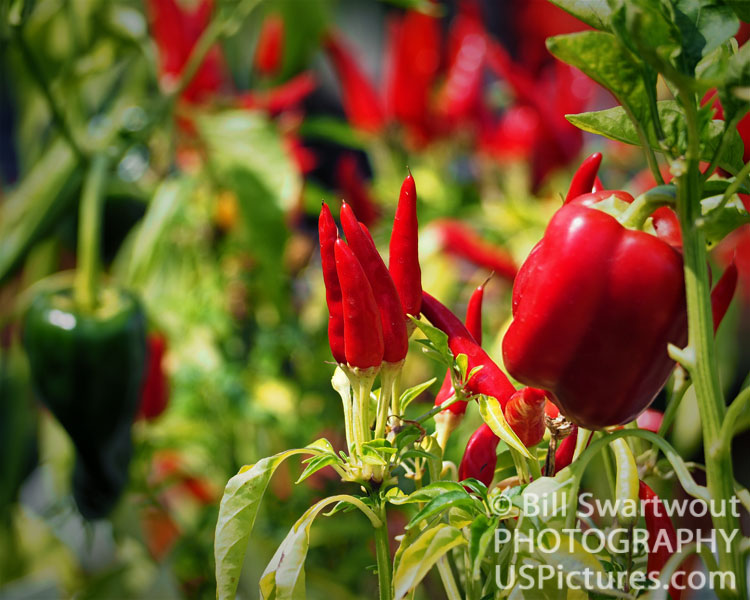
How about some red hot chili peppers to spice up that blank wall in your kitchen? Hot peppers are all the rage these days – just look at the gazillion jars of hot sauces available at any gourmet market. These peppers, in blazing bright red, photographed at a farm market in Delaware, are the epitome of chili peppers and would certainly brighten up any place you decided to display them as wall art. Or what do you think about these depicted on coffee mugs or maybe even hot chili pepper throw pillows.

Red Hot Chili Peppers from a farm store in Rehoboth Beach, DE.

Then there is always popcorn. Right? How about this as a design element in itself. Everybody likes popcorn and this display of Carmel Popcorn, while photographed at Broadway at the Beach in Myrtle Beach, South Carolina, might be found in just about any beach town – anywhere. Can you imagine how challenging this would be as a jigsaw puzzle. Absolutely and, yes, this is available as a quality jigsaw.

Caramel Popcorn on display at Broadway at the Beach in Myrtle Beach, SC

Click the links below to see a bit more about each image and/or to browse/shop for wall art (for you kitchen, perhaps) or for a home decor item as a conversation piece.

Link: Best Onion Rings Ever

Link: Red Hot Chili Peppers

Link: Caramel Corn Behind Glass

Link to: Bill’s Food As Art Collection at Fine Art America – where you can see many other examples of “Food as Art” that may get your creative juices flowing.